


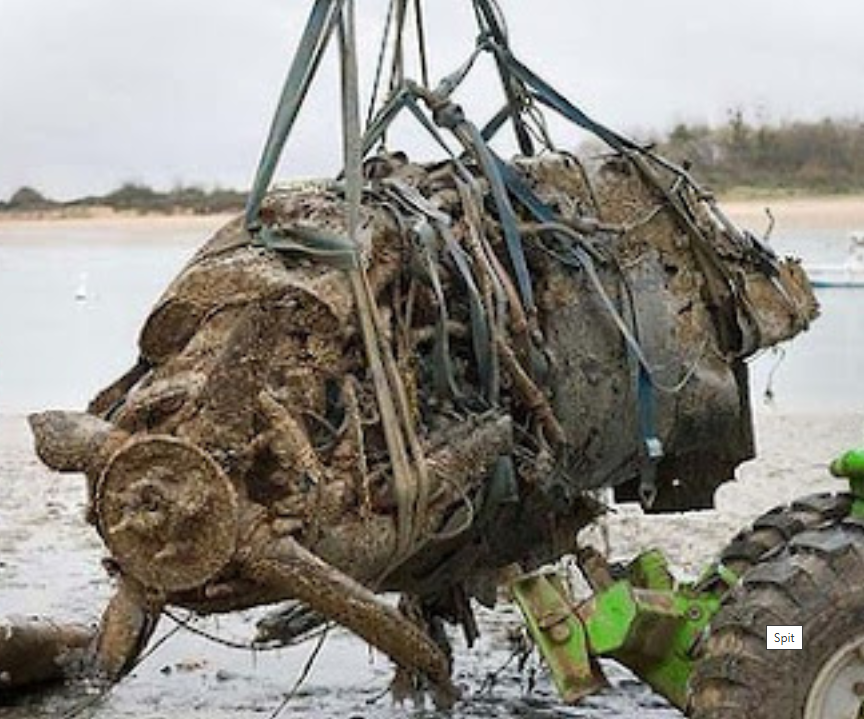

The pilot, identified as Flight Lieutenant Henry `Lacy’ Smith, 27, from Sydney, was buried with full military honors in France in April.
Now a team of experts in Melbourne are doing their best to preserve what is left of his plane.
The Spitfire MJ789 was shot down by anti-aircraft fire on June 11, 1944 in the battle that followed D-Day.
It crashed into the River Orne, near Caen, in northern France during the Battle of Normandy, one of the largest battles of WWII.
Smith and his aircraft were deemed missing in action until they were found last November in the Orne Estuary by local museum curators.
The aircraft remains were shipped to Australia in September where experts at the RAAF Museum at Point Cook in Melbourne are removing the dirt, slime and foreign matter.
Despite its history, the plane – which has two bullet holes in its right wing from where it was pounded with anti-aircraft fire – is in good condition.
“It looks fairly good for something that’s been laid in the salt water since 1944,” museum director David Gardner said.
“It’ll be conserved in its current form and the way we put it on display will tell the story of the RAAF’s contribution to the war effort in Europe.
“It will also add to the fact that we are actively looking for those that are declared missing during the conflict.”
The conservation effort will involve cleaning the aircraft, then hoisting it into a tank of fresh water for between six and eight months to desalinate it before it is preserved for the long term.
“We’ve got to get rid of the salt so we can stop the corrosion and corrosion’s the biggest killer,” Mr Gardner said.
Smith was from No 453 Squadron, the first Australian squadron to go into action on D-Day – June 6, 1944 – providing tactical support for the troops landing on the Normandy beach head.
He was buried with full military honours at the Commonwealth War Graves Cemetery at Ranville, Normandy, in April.
Gary Walsh, a registrar at the museum who is working on the preservation, said he felt fortunate to work on the project.
“It’s a very poignant moment for me,” he said.
“There were some brave people involved with this and unfortunately this person lost his life defending his country.
“It’s a sacred thing from our perspective too.”
Staff hope to have the plane on display in the next six to eight months.