


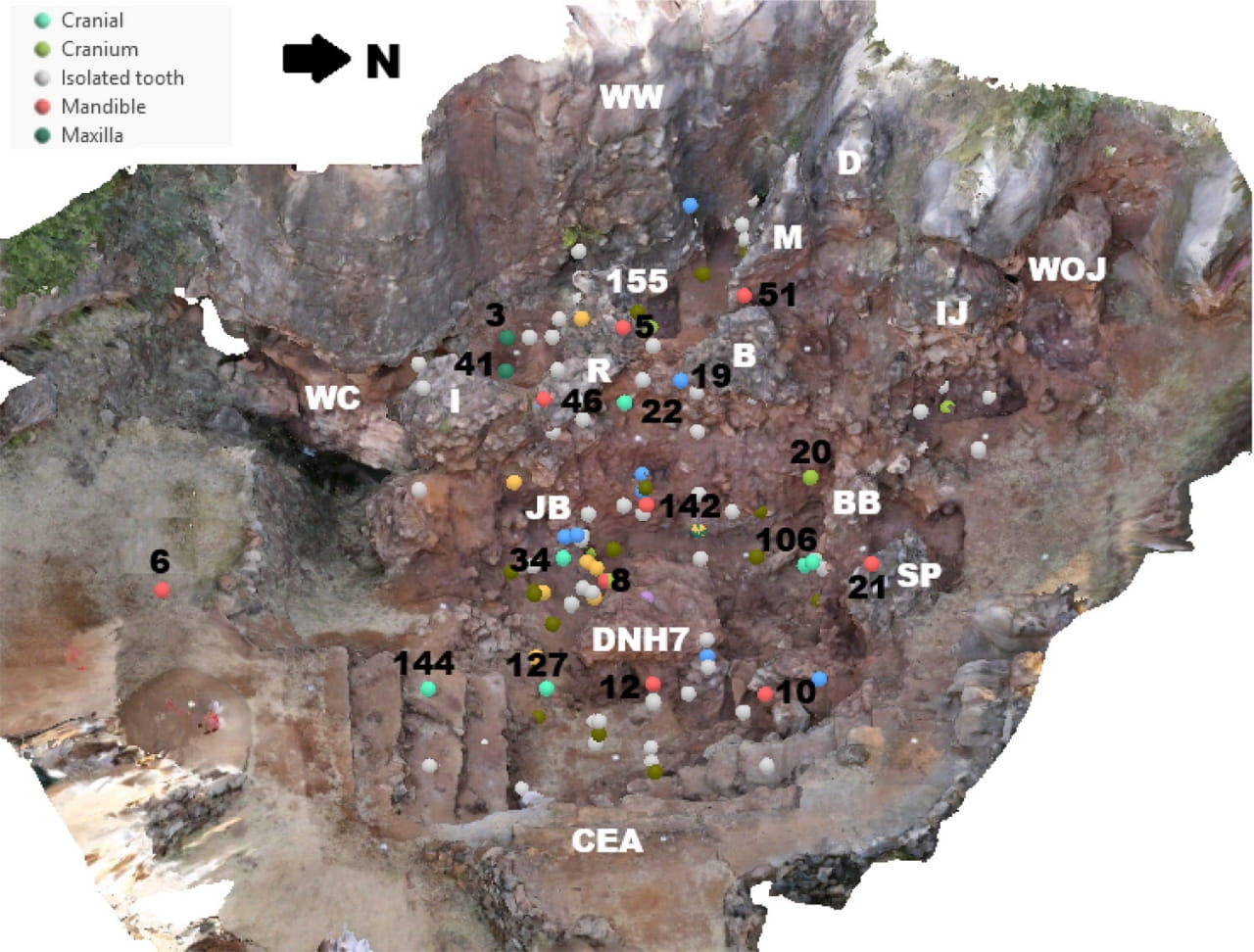

A new set of fossils from South Africa’s Drimolen Main Quarry adds evidence for an early appearance of Homo erectus and tracks changes in Paranthropus robustus.

Researchers from La Trobe University and partner institutions studied 18 hominin fossils excavated at Drimolen between 1992 and 2019. Many had never received a full description, leaving parts of the site’s fossil record unavailable for study.
One fossil, a skull fragment known as DNH 127, belongs to an adult Homo erectus. The specimen dates to about 2.04 to 1.95 million years ago. The find adds support to earlier evidence from Drimolen for the species at roughly 2 million years ago.
The earlier evidence included DNH 134, a fossil from a child aged about two to four years. Researchers had less information about what an adult Homo erectus looked like at the site. DNH 127 now provides an adult example from the same early period.

The age of the fossil places the South African record for adult Homo erectus well before the 1.8-million-year-old adult fossils from Dmanisi in Georgia. The evidence supports an early appearance of Homo erectus in southern Africa around 2 million years ago.
Homo erectus is an early member of our genus Homo and a likely ancestor of later humans. The fossil places the species alongside Paranthropus robustus.
Of the 18 newly described fossils, 14 belong to Paranthropus robustus. One belongs to Homo erectus, while three remain assigned to Hominini gen. et sp. indet. The group also identified a new jaw feature helping distinguish the Drimolen Paranthropus fossils from samples at other South African sites.
The findings support the idea of a distinct Drimolen population of Paranthropus robustus. Researchers compare the fossils with remains from Swartkrans and Kromdraai, including material dating to about 1.8 million years ago.
The differences point to small changes within Paranthropus robustus over roughly 200,000 years. Teeth became larger, along with the muscles used for chewing. The pattern fits a shift toward a stronger chewing system for processing tough and hard foods.

The two hominins followed different physical paths during the same period. Homo erectus had a larger brain and smaller molar teeth. Paranthropus robustus kept a brain size only slightly above chimpanzee brain size while developing very large molars and strong chewing muscles.
Both species lived in the same broader landscape and appear in the Drimolen cave deposits. Population numbers at the site did not favor the lineage later linked to modern humans.
At Drimolen, Paranthropus robustus outnumbered Homo erectus by more than 10 to one around 2 million years ago. The pattern shows both hominins living together while following separate evolutionary paths.
The researchers also support the name Paranthropus robustus ukusa for the distinct Drimolen population. The study finds enough anatomical differences in the new fossils to support this grouping.
Drimolen Main Quarry lies within South Africa’s Cradle of Humankind, one of the richest fossil areas for human ancestors. Excavations since 1992 have produced a large collection of hominin remains. The newly described fossils add more detail to a record with many undescribed specimens.
The study, published in Annals of Human Biology, uses anatomical descriptions, comparisons, and measurements to assess the fossils. The large Drimolen sample offers a detailed record of small anatomical changes among early human relatives.