


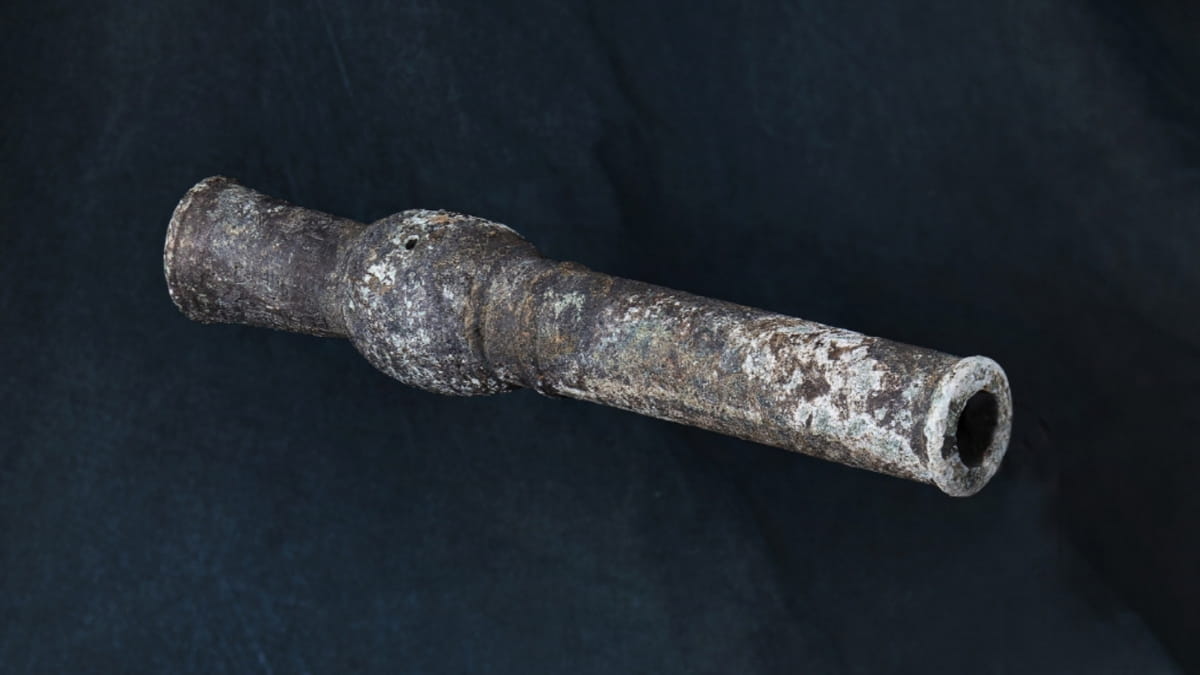

A small bronze gunpowder weapon found on a Korean mountain is now identified as the country’s earliest surviving firearm.

The weapon, known as the Hwangja Hwatong, was found in November 2023 on Geumseongsan Mountain in Naju. Workers found it during a mine detection sweep before construction work for a mountain trail.
The firearm measures 23.75 centimeters long, with a bore measuring 1.66 centimeters across. It weighs 1,032 grams. Researchers at the Naju National Research Institute of Cultural Heritage spent three years studying its metal, form, inscription, and date.
The weapon belongs to a class known as hwatong, or “fire tubes.” These gunpowder weapons fired arrows or shot and offered greater range and force than bows.

The Hwangja Hwatong carries 28 inscribed characters. Twenty-seven characters appear in six columns on the shaft socket, while one character appears near the muzzle.
The inscription gives several details about the weapon’s production. It records the year, the month of manufacture, the weapon’s name, its weight, the official who supervised its production, and the artisan who made it.
Researchers read the main inscription as stating that the Hwangja Hwatong was made in the twelfth month of a Jeongsa year. It also gives its weight as one geun and 14 nyang and names Noksa An Hyu-bo as the supervising official. The artisan is named Seok.
Hwangja, meaning “yellow character,” refers to a class of weapons named according to the order of characters in the Thousand Character Classic. Noksa was the title held by the official who supervised production.

The Jeongsa date points to two possible years, 1377 or 1437. The first falls during the reign of King U of Goryeo, when the Hwatong Dogam, or Directorate of Gunpowder Weapons, was established. The second falls during King Sejong’s reign, when firearms underwent major changes.
Researchers place the weapon among the earliest Korean gunpowder arms based on its design and metal composition. The powder chamber has a round interior, unlike the improved firearms produced during King Sejong’s reign.
Tests of the bronze also found features consistent with traditional casting methods. These findings support the early date indicated by the inscription.
The find has unusual research value because researchers know exactly where the weapon was found. Its inscription also links the firearm to a specific period and names both its maker and supervisor.
Physical examples of gunpowder weapons from late Goryeo and early Joseon Korea are rare. The Hwangja Hwatong therefore provides a rare surviving example of early Korean firearms.
The Naju National Research Institute of Cultural Heritage will present the weapon at the National Palace Museum of Korea from September 23 through November 22. The Hwangja Hwatong will form part of a special exhibition featuring newly found artifacts.