



Around 13,800 years ago, hunters set up camp on a small ridge above the Tanana River in interior Alaska. Spruce trees cover the spot today. Back then, shrub tundra rolled across the land. Archaeologists now call the place Shég’ Xdaltth’i’, an Athabascan name meaning “they were there.”

Kelly Graf, an anthropology professor at the University of Kansas, led the team behind the study, published in Science Advances. Ted Goebel, the department chair, doctoral student Mia Harbort and undergraduate Mason Sewing co-wrote the paper with researchers from the U.S. and Europe. Their work covers three occupation layers dated to 13,800, 13,000 and 12,700 years ago.
The location matters because of the Bering Land Bridge. This stretch of exposed land and coast joined Asia to North America. Formed about 35,000 years ago, the bridge sank under rising seas around 12,000 years ago. Crossing the bridge was a major step in settling the Americas, yet the region’s archaeological record is still poorly understood. Known sites sit packed into an area slightly larger than Maryland, so every well-preserved camp counts.
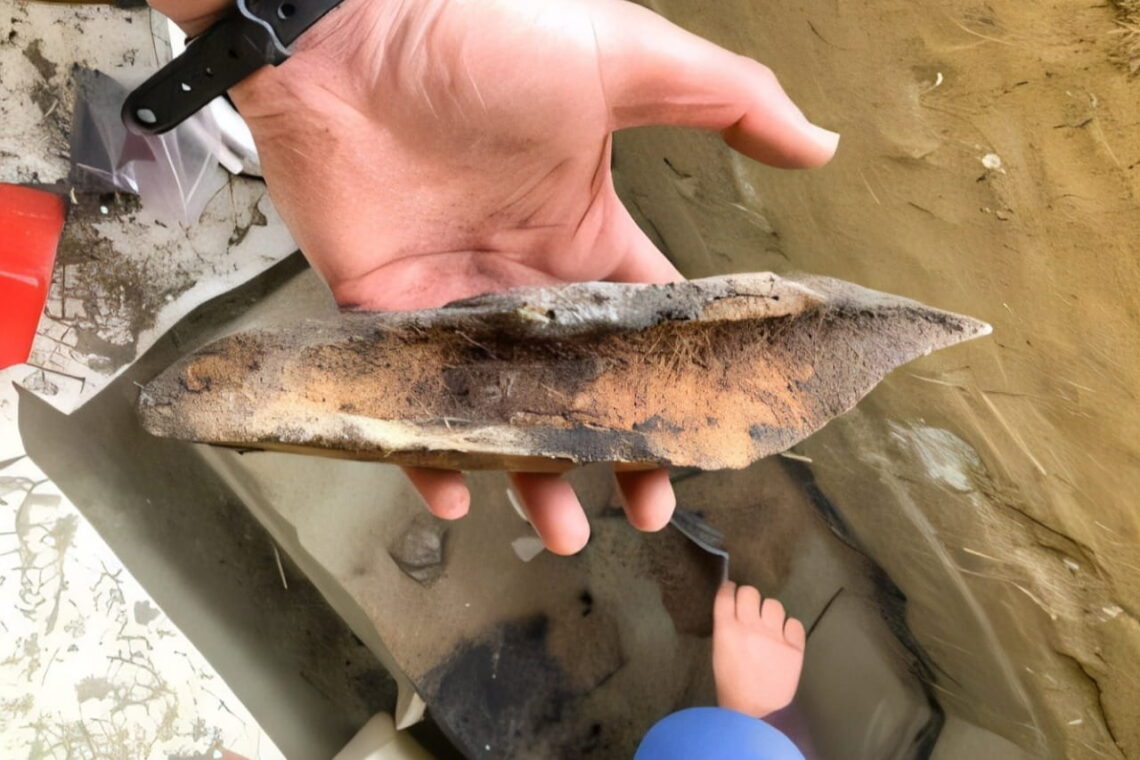
Shég’ Xdaltth’i’ isn’t Beringia’s oldest site. The oldest layer, though, holds a record no other site of this age matches. Excavations have turned up more than 80,000 specimens. Among them are a distinct hafted-biface, which is a stone blade shaped on both sides and mounted on a handle, along with bone tools, needles made from bird bones, animal remains and well-preserved activity areas.

The hunters took mammoth, bison and horse, all extinct today. They also took caribou, which Indigenous people in Alaska still hunt. One find stands out for Graf, a large stone anvil inside a dwelling. Smashed bison bones and quartz hammerstones lay all around. The team thinks people broke the bones open to get marrow and render grease, and a big earth oven stood close by.
The diamond-shaped stone points tell a bigger story. Graf says no other site in Alaska has this clear diamond shape. The only northern sites from this time with similar points sit on the Russian side of the land bridge. The study also names Shég’ Xdaltth’i’ the earliest known Nenana Complex occupation east of the bridge. Sites of the same age west of the bridge share the point style, giving researchers a cultural link across Beringia. Graf says this points to people crossing the land bridge to this spot, and possibly from here.
Graf first made the long trek to the site in 2013 and returned every year until the COVID-19 pandemic. She went back in 2021, 2023 and 2025. The multi-disciplinary study began in 2016, and she directs the excavation.
Graf studies Ice Age archaeology and the peopling of the Americas. In her view, the past shows how people have responded to hard times. Humans grew from a handful of individuals in one small region to more than 8 billion in a sliver of geological time, and each new site fills in part of how they got there.