


On June 03, 1982, one of the most remarkable episodes in the history of the Brazilian Air Force (FAB) took place. A calm morning in Rio de Janeiro would be interrupted by sonic booms from a pair of F-5E Tiger II fighters from the 1st Fighter Aviation Group, leaving to intercept a British Avro Vulcan bomber that had invaded Brazilian airspace.
The story begins the day before, when the six crew of the Vulcan B.2 XM597 were taking off from Ascension Island for a long mission, the sixth in the Black Buck mission sequence.
The objective of the mission led by Squadron Leader Neil McDougall was to destroy Argentine radars in the archipelago invaded months before by troops from Buenos Aires. For this, the British took off with four anti-radar missiles AGM-45 Shrike, of North American origin and that were adapted to nuclear bombers.

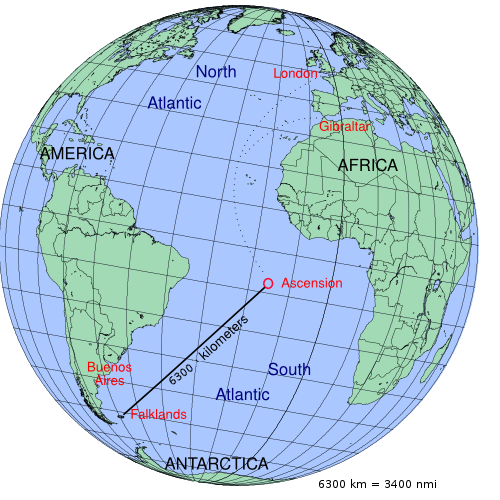
Black Buck missions are among the longest and most complicated in the history of modern military aviation. Ascenção Island is located in the middle of the Atlantic, 6300 km from the Falklands/Malvinas. Thus, the bombers needed the support of eleven (!) Handley-Page Victor in-flight refueling (REVO) planes, which also transferred fuel between themselves to complete the mission, which had about 16 hours of duration.
The British arrived on the island in the south Atlantic and waited until the Argentines turned on one of their radars. In the cockpit, signals from a SkyGuard radar were picked up. Promptly two missiles were launched against the target, which was destroyed. The XM597 crew then begins their return to Ascenção. Then, things started to go wrong.
During the 5th REVO, the Vulcan’s resupply probe broke down and the aircraft became unable to reach the British Isle. The only option left was to land in Rio de Janeiro.
Brazil maintained neutrality in relation to the conflict, which generated serious tensions in South America. Even so, FAB AT-26 and P-95 planes were passed on to the Argentines.
Neil traced a direct route to Galeão International Airport, but first the XM597 crew needed to solve two problems: eliminate secret documents and get rid of the two anti-radar missiles that were still hanging from the Vulcan bomber.
The documents, which contained mission data, charts and maps, were placed in a military ration can. The aviators put weights on the “package”, so that it sank in the ocean waters. A hatch on the plane’s floor was opened at 43 feet, depressurizing the plane but ensuring that the documents would go down the drain.

There still remained the problem of missiles. The pilots fired one of the Shrikes, but another one ended up getting stuck in the plane due to technical problems, which made the situation even more complicated.
And it was in this scenario that the XM597 crew came into contact with Brazilian control. Using radio code Ascot 597, the military told control that they were in a British four-engine with an emergency on board and low on fuel. Brazilian air traffic control denied the Ascot entry into national airspace, but having no other alternative, McDougall continued taking the plane to Galeão.
At the same time that the British crew was trying to save themselves, a pair of F-5E fighters were being prepared for a training mission at Santa Cruz Air Base, in the south of RJ. While they were manning the jets, captains Raul Dias and Marcos Coelho received the information: Rojão de Fogo.
Within the FAB, these words mean a real invasion of Brazilian airspace. Mechanics manned the 20mm cannons in the nose of the fighters, while the pilots powered the planes. At 09:57 am, the F-5 4832 and 4845 took off from Santa Cruz, receiving instructions from the Military Operations Center (COPM) to proceed to the target at supersonic speed.
Once they broke the sound barrier, the fighters generated a rumble over the river, shattering windows and panes as they proceeded to intercept the British Vulcan.
Accompanied by the F-5, the Vulcan did not make the landing circuit to runway 32 at Galeão Airport, executing a direct approach. After landing, the Tigers returned to Santa Cruz. The aircraft was so low on fuel that it suffered a dry breakdown while taxiing, being towed to Galeão Air Force Base.
The incident generated tremendous diplomatic “stress” between Brazil, Argentina and England. Even so, Itamaraty acted in accordance with international law: for a week the plane and the crew were detained in the country, taking off back to Ascenção on 10/06, with the condition that the XM597 was no longer used against Argentines, who still protested the release of the aircraft by the Brazilian authorities.
What happened to the Shrike missile is still a matter of debate. While some sources say that the weapon was completely confiscated and studied by the Brazilian military – leading to the development of the MAR-1 missile, whose project was abandoned -, others report that it was later returned.

Still, the war ended early for the Vulcan crew. Four days after their departure back to Ascension Island, Argentina surrendered to the British, ending a war that generates controversies and disputes to this day.
Brazilian and British airmen are already in the reserves of their respective air forces, naturally. Like its crew, the XM597 was also retired and is now preserved at the National Museum of Flight in Scotland, with two Shrike missile marks and the Brazilian flag painted below the left window.
The F-5 4832 was lost in an aerial collision on 16/04/1985 during a low-level flight in the region of Passa Quatro (MG), killing Captain Waldemar Estevão Alonso. The FAB 4845, on the other hand, was modernized and is still in operation.