


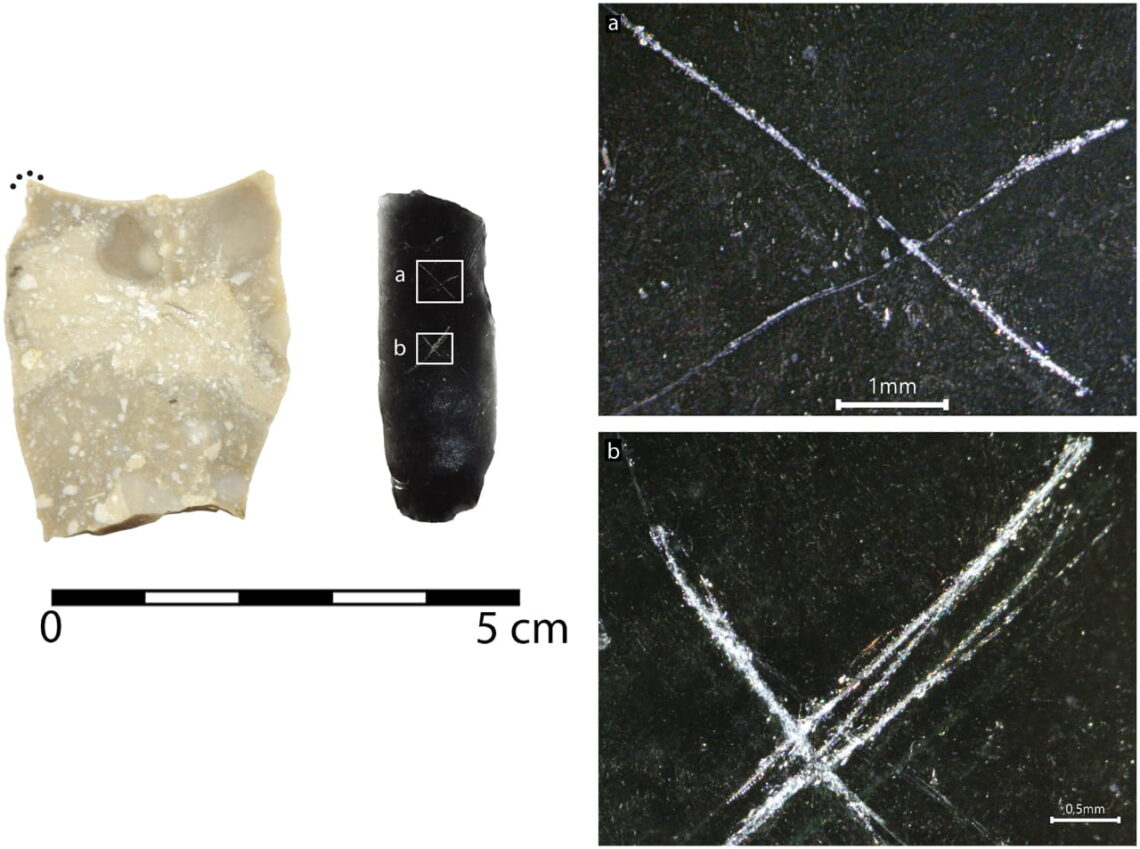

Archaeologists have found 11 more carved obsidian arrowheads at Tepecik-Çiftlik in Cappadocia, Turkey. The finds raise the site’s total to 12 and add to a regional group of 54 known examples.

The arrowheads date to the Neolithic, between the late eighth and seventh millennia BCE. They belong to a rare practice found only in Central Anatolia. Some examples span more than a thousand years, yet the reason for the marks is still unclear.
Tepecik-Çiftlik was home to farming and herding communities between about 7100 and 5800 BCE. People also hunted there. The site sits near major sources of Cappadocian obsidian, a volcanic glass widely used for tools and weapons.
The 11 new pieces were found after researchers began checking the site’s arrowheads more closely. Before the study, only one incised example was known from Tepecik-Çiftlik.

The marks differ greatly from one arrowhead to another. Some sit near the center, others close to an edge. Some were cut before final shaping. Others were added after the arrowhead was finished.
One piece carries a design made with at least 20 strokes. The lines form three squares joined by a line. Other pieces have simpler marks. No two designs are identical.
The study found no clear link between the marks and how the arrowheads were made or used. The incised pieces look and function like other arrowheads from the site. Wear patterns don’t set them apart.
The researchers tested whether the lines formed by accident during tool production. Microscopic study showed deliberate cuts. Obsidian won’t scratch obsidian, so the team tested flint tools. The experiments produced similar marks.
Flint was rare at Tepecik-Çiftlik, making up about 1% of the stone flakes. Making the marks involved a deliberate choice of material. Some designs required many strokes before a white line appeared against the dark obsidian.

The arrowheads also show a strong regional pattern. Cappadocian obsidian traveled far beyond Central Anatolia, including to the southern Levant. Yet no comparable incised arrowheads have been found outside Central Anatolia.
Similar marks from other sites suggest some shared tradition. The designs still vary too much to form a fixed set of signs. Researchers see broad links between sites, but no standard system.
One earlier idea, proposed by archaeologist Kathryn Ataman in the 1980s, holds the marks were hunters’ signs. A hunter might have marked an arrow to identify the person who killed an animal. The new finds don’t rule out this idea, but they don’t prove it either.
Other explanations remain possible. The marks might have shown personal or group identity, carried symbolic meaning, or served another purpose. Their presence in homes gives little support for a special ritual use.
The long life of the practice raises another question. Central Anatolian communities changed in many ways during this period. Yet people kept making these rare marks for more than a millennium.
The study points to a specific local custom rather than a widespread Neolithic tradition. Obsidian was easier to mark than harder stone. Still, the effort needed to cut the points suggests more than simple convenience.
Researchers now hope for finds from burials. A marked arrowhead found with a person or burial goods would offer a stronger clue about who used the marks and why. For now, the growing collection leaves the main question unanswered.