


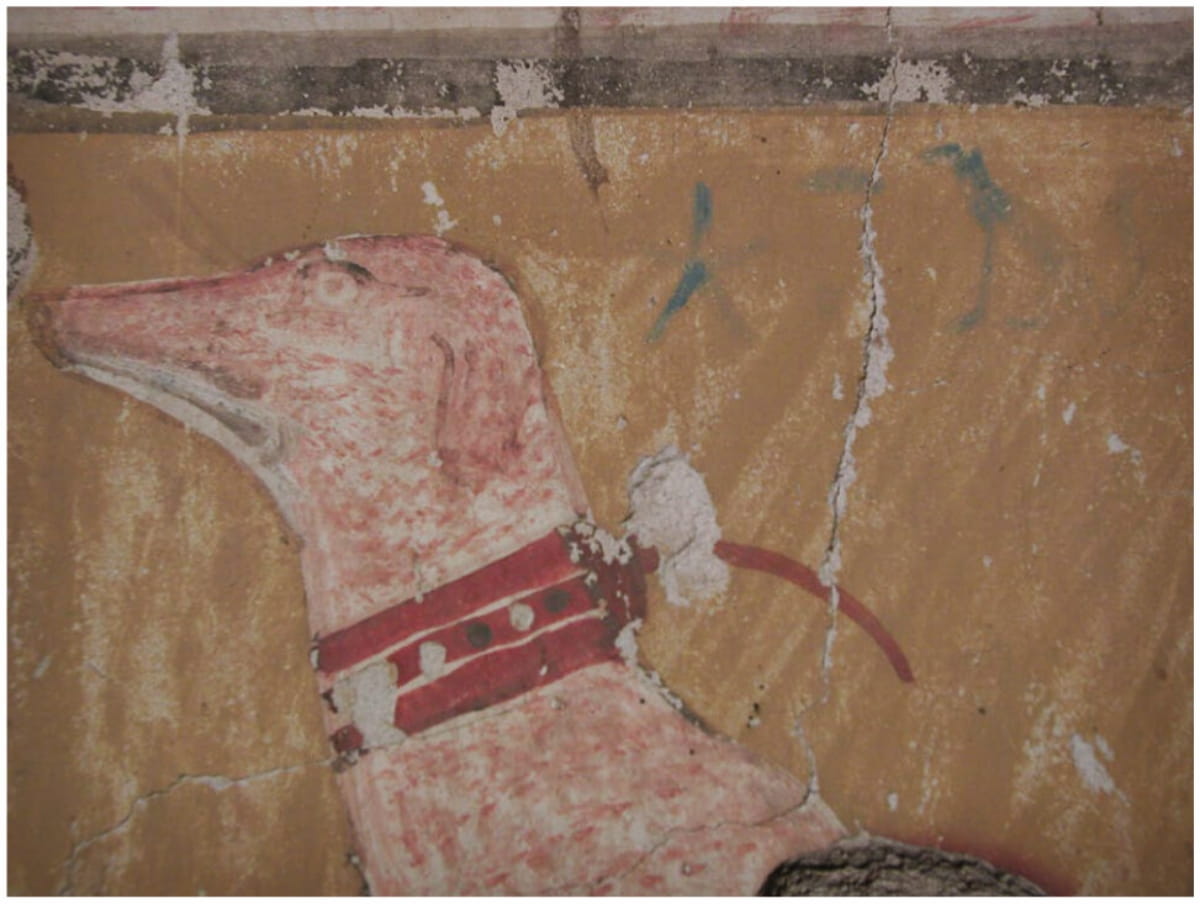

A faint name beside a dog in an ancient Egyptian tomb has added a new name to the known list of Egyptian dogs. The name appears in the 18th Dynasty tomb of User, a scribe and steward of Thutmose I, at Sheikh ‘Abd el-Qurnah in the Theban cemetery.

Nearly 100 dog names from ancient Egypt are now known. They span the Old Kingdom through the Ptolemaic Period. Many refer to a dog’s appearance or behavior, including coat color and personal traits. Some names also appear as human names, showing how closely dogs were tied to human life and society.
More than half of the known dog names come from private tombs. Tomb owners often included dogs in scenes connected with daily life and their own identities. Naming a dog in such a scene gave the animal a more lasting presence within the tomb.
Ancient Egyptians also viewed tomb images as part of preparations for the Afterlife. Images of people and animals formed part of this setting, while names helped preserve the identity of the person or animal shown. A named dog therefore had a place within the tomb owner’s efforts to maintain a connection with the deceased and his world.

The tomb of User, known as TT 21, offers an unusual example. Its inner chamber contains four offering scenes. At least three show a dog sitting beneath User’s chair. The fourth lower wall section is damaged, so the presence of a dog there is uncertain.
All three surviving dogs wear collars and sit upright beneath User. They share the form of a sloughi, a thin New Kingdom dog with long legs, drooping ears, and a curved tail.
Earlier work on the tomb recorded names for only two of the three dogs. One was ḳn[j]j, meaning “Strong one,” while the other was mȝʿty, meaning “Trusty.” A closer examination of the third scene found a faint name above the third dog’s head.
The name became much clearer after the researchers processed the image with filters using the DStretch plug-in in ImageJ. The enhanced image showed writing behind the dog’s head, despite the faint original paint.
The scene shows User seated before a pile of offerings with a floral bouquet near his nose. Beneath his lion-footed chair sits a white, collared dog with a red rippled coat pattern. The pattern gives the dog a distinctive appearance while also echoing User’s clothing.

The dog’s name reads dwȝ.ty. Linguistically, the name is a derived adjective expressing origin. The researchers translate it as “He-of-the-Underworld,” an epithet associated with Anubis, the Egyptian god linked with the dead.
The name is especially unusual because no other known Egyptian dog bears the same name. A related form appears at least once as a human name, but dwȝ.ty has not previously been recorded as a cynonyme, the term used for an ancient Egyptian dog name.
The writing also contains an unusual sign for dog. Egyptian dog names sometimes included a determinative, a sign helping define the meaning of written words. Most examples use a standing dog sign with upright ears and a curled tail.
The three dogs in User’s tomb break from this pattern. The determinatives beside the first two names were altered to resemble the sloughi dogs shown in the scenes. The sign beside dwȝ.ty goes further. It shows a seated dog and closely matches the posture of the actual animal beneath User’s chair.
Only one other seated dog determinative is known among the Egyptian dog names. The unusual sign therefore adds another feature separating dwȝ.ty from the known group.
The researchers argue that the name likely refers to Anubis. The reason for the seated dog sign is less clear. Still, the artist treated this dog differently from the other two dogs in the same tomb.
Its coat pattern is unusual, its name has no known parallel among Egyptian dogs, and its written dog sign closely follows the animal’s seated form. Together, these details make dwȝ.ty a distinctive addition to the record of ancient Egyptian dog names.