


In 1963, USS Thresher sank, killing all 129 aboard—sparking decades of speculation. It remains the deadliest submarine accident in U.S. history.
On April 9, 1963, USS Thresher, the lead nuclear-powered attack submarine of her class, was conducting deep diving tests about 220 miles east of Cape Cod. A behemoth built to hunt and destroy hostile enemy submarines during the Cold War, she clocked in at 278 feet in length, displacing 4,369 tons underwater. Thresher could charge ahead at speeds of up to 30 knots while submerged, yet it was the quietest and fastest submarine of her time.
During the exercises, Thresher dove slowly in a circular pattern beneath USS Skylark, a Penguin-class submarine rescue ship. The sub maintained communications and made stops about every 100 feet to check the integrity of its systems. But when Thresher reached its intended test depth of 1,300 feet, things began to go awry. She notified the surface ships monitoring the tests that the sub had been encountering “minor difficulties,” and that it would blow its ballast tanks to return to the surface. Sonar technicians reported hearing mysterious “air rushing” noises—but the sub never surfaced.
The U.S. Navy later found the sub in six pieces on the bottom of the Atlantic Ocean. All 129 personnel on board, including 112 crew members and 17 civilian contractors, died in the tragedy. It remains the deadliest submarine accident in U.S. history.
People have come up with many theories about how the sub sank, like blaming Thresher’s faulty welds that failed during dive tests, shorting out the sub’s critical electrical systems and sapping its power. However, a trove of recently declassified files detailing the 1963 sinking reveals there was no single event or error that caused the sub to sink.

The sub rescue ship USS Preserver and bathyscaphe Trieste attempt to locate USS Thresher, June 1963.
The Navy’s investigation into the sinking remained classified for decades until James Bryant, a retired U.S. submarine commander of three Thresher-class ships, sued the service in 2019 to release the files. In 2020, a judge agreed with Bryant, ordering the declassification of 3,600 pages of documents. U.S. Naval Institute News has uploaded many of the files online for public viewing.
The Navy officially said improperly welded piping ruptured onboard the ship, causing a seawater leak that eventually shorted out the ship’s electrical system. Crews were unable to reach equipment to stop the flooding in time, and the ballast tanks failed to work properly.
Meanwhile, naval historian Normal Friedman believes inadequate training exacerbated these problems, with the crew unable to respond quickly enough to save the ship. Bryant and other naval experts believe the declassified files show several factors all came together to create the perfect storm.

Artistic rendering ofUSS Thresher firing torpedoes. The Thresher would have fought against the Soviet Union.
According to the panel of experts, the Navy was rushing to get Thresher into the fleet to counter a new class of Soviet nuclear submarines. An expansion of the submarine fleet created a demand for more sub-trained crews, and some suggest crews went to sea inadequately trained. The crews themselves were overconfident in the systems, believing it was impossible for nuclear-powered submarines to lose power.
Today, the legacy of USS Thresher lives on. It was a first-of-its-class nuclear-powered attack sub, only the second to use the new teardrop hull designed to maximize speed underwater. Unlike conventionally powered submarines, nuclear-powered subs could stay underwater indefinitely and didn’t require an efficient hull shape for sailing on the surface. The Threshers were also the first subs to use the newer, stronger, HY-80 steel alloy.
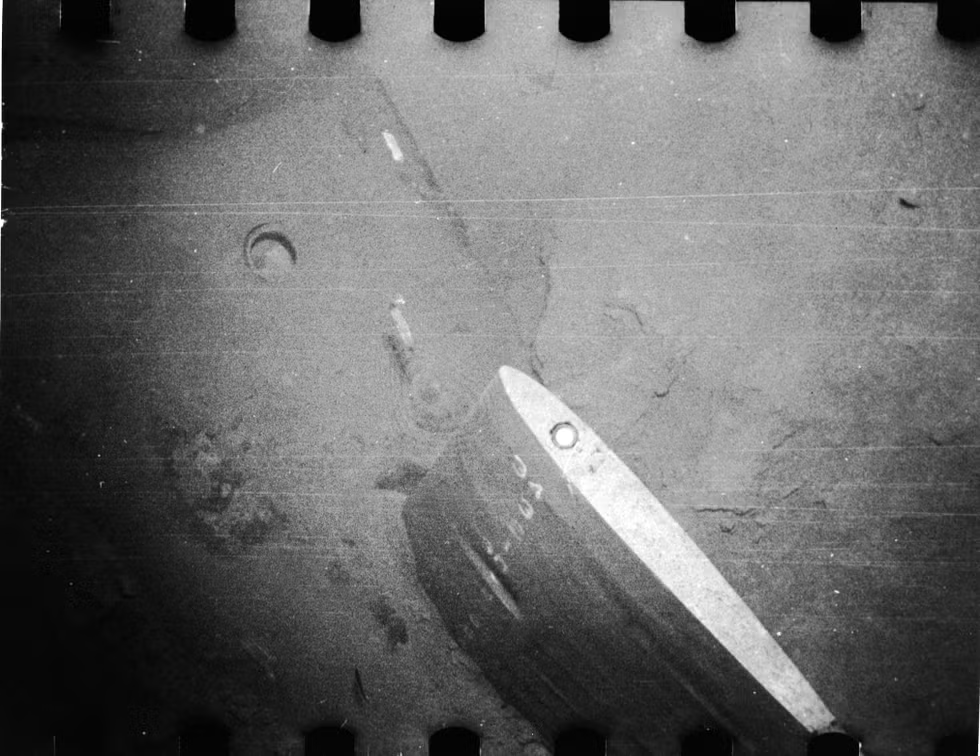
Remains of USS Thresher, September 1963.
But perhaps the greatest way Thresher endures is through improved safety protocols. Its tragic sinking, as well as the loss of USS Scorpion in 1968, led to a revamping of both training and engineering practices aboard Navy nuclear submarines.
“That was very much an eye-opener for the submarine community; a devastating accident that forced us to really take a hard look at what we were doing and how we were designing, building and sustaining submarines going forward. The loss of the Thresher brought about a change in how we do submarine design, to minimize the possibility of this ever happening again,” Rear Adm. Scott Pappano, program executive officer, Strategic Submarines (SSBN), said in a 2023 press release.