



Archaeological work at Posaer Berg in Saxony-Anhalt, Germany, is revealing new details about a major early medieval site. Research digs have taken place there since 2017, led by the State Office for Heritage Management and Archaeology of Saxony-Anhalt.

The site holds remains from several important phases. These include a fortified settlement from the ninth and 10th centuries, the later seat of the Bishops of Zeitz, and a Benedictine monastery founded in 1114.
This year’s work has focused on the southern part of the early medieval fortress. The site stands on a hill above the White Elster floodplain, giving the settlement a strong strategic position.
The fortress covered more than eight hectares. It had a central stronghold on the hilltop and a larger outer area to the east. Steep slopes formed part of the defensive system.
Archaeologists have now exposed early structures on the southern side of the central fortress. One important find is a corner of a thick wall, identified through a large robber trench. The wall was about 1.7 meters wide and could have formed part of a ninth or 10th-century tower.
The tower appears to have joined a wall surrounding the southern edge of the stronghold. A fire destroyed or damaged this defensive line in the late 10th century. The fortifications were then moved farther south.

Buildings later occupied the space left behind. Their wall trenches overlap the earlier defensive remains. Excavations have produced large amounts of material from these structures, especially pottery. Further study of the finds should help establish more precise dates for the different building phases.
The fortress also became the seat of the Bishopric of Zeitz in the 10th century. Emperor Otto I founded the bishopric in 968 during the creation of the Archdiocese of Magdeburg. Zeitz then became an important center of power within the empire during the late 10th and early 11th centuries.
The bishop’s palace was one of the main buildings within the complex. Excavations have exposed about 30 meters of the structure, which was roughly 18 meters wide and likely had several floors.
This year, archaeologists found a north-south wall dividing its lower level. One room still had a plaster floor built over a carefully arranged layer of small stones. A wide opening was also found in the southern wall. Its position suggests the entrance or opening once had some form of roofed protection outside.
The palace shares features with early medieval buildings in Paderborn, Goslar, and Merseburg. Glass windows were also present, an expensive feature for the period.

After the bishopric moved from Zeitz to Naumburg in 1028, the complex continued in use. In 1114, Bishop Dietrich I of Naumburg founded a Benedictine monastery at Posa. Monks arrived from Hirsau in the northern Black Forest.
Recent excavations have now changed the picture of the monastery’s southern boundary. Archaeologists found a second courtyard surrounded by additional buildings. Earlier, the southern edge of a 16th-century paved courtyard was thought to mark the monastery’s limit.
The new finds show the complex extended much farther south. A small Romanesque building was uncovered, though its purpose is still unknown. Another building stood beside the southern side of the second courtyard.
Both structures had signs of high-quality construction. Two hot-air heating systems from the 14th century were found, along with a fine red plaster floor.
The monastery’s water system offers another rare find. Archaeologists have documented many wooden pipes used from the 12th century onward. Written records show water was brought from more than four kilometers away by 1168.
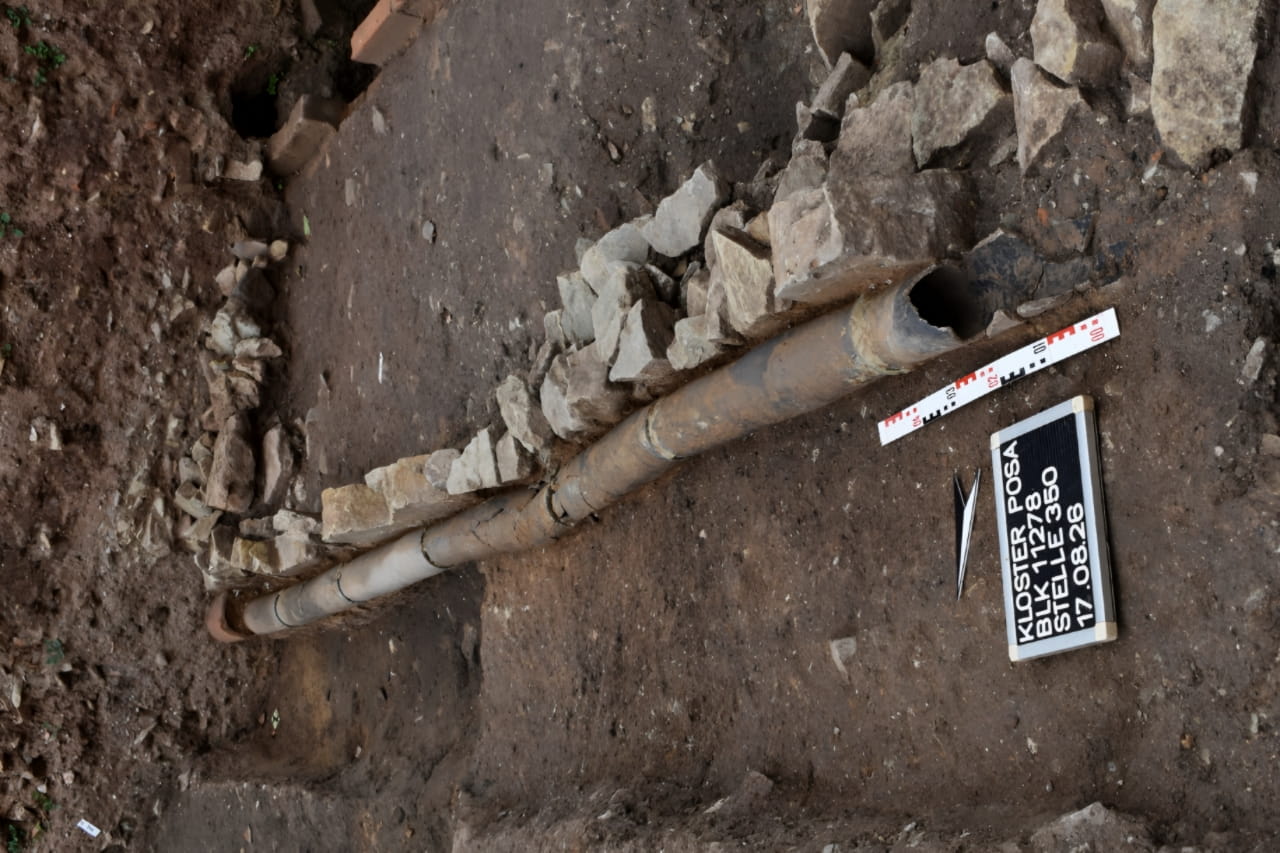
A section of a clay water pipe has now been found in the southern courtyard. The pipe dates to the 14th century and was traced for about five meters.
The system used clay tubes about 70 centimeters long and 12 centimeters wide. Potters made the tubes on a wheel and fired them. Shaped ends allowed the sections to fit together, while clay sealed the joints.
Early clay water pipes of this type are rare. Similar examples have been found at only a few southern German monasteries and castles.
The heating systems and water pipes point to a well-developed monastic complex in the late Middle Ages. They also provide evidence for continued investment in the monastery during a period often linked with decline.
Excavations will continue after the six-week student training dig ends in mid-October. The next phase will focus on the early medieval structures along the southern edge of the fortress.