


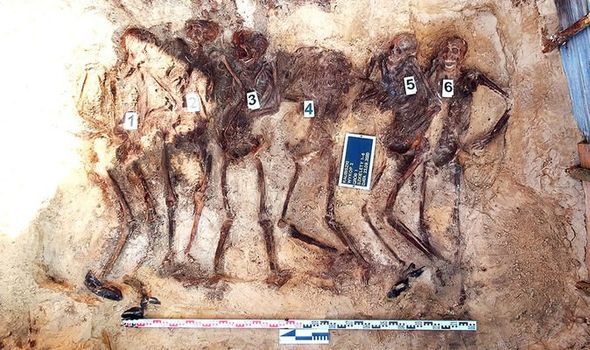

The archaeology find concludes a month-long search for the remains of Polish partisans and underground soldiers fighting the Soviet regime in 1945. The discovery was made in Lithuania where the Polish Institute of National Remembrance (IPN) has been carrying out excavations for a number of years now. Lithuania, which borders Poland to the northeast, was a Soviet satellite between 1940 and 1941, and 1944 and 1990.
This year, a team of IPN archaeologists was tasked with finding the remains of soldiers led by Sergiusz Koscialkowski, whose nom de guerre was Fakir.
The 29-year-old partisan made his mark fighting Nazi Germany and the Soviet Union during the occupation of Poland between 1939 and 1945.
An analysis of documents and eyewitness statements led the archaeologists to the village of Raubiskiai, to the northeast of the capital Vilnius.
The researchers trawled through more than 32,000 square feet of land and collected more than 3,000 samples of soil for analysis.

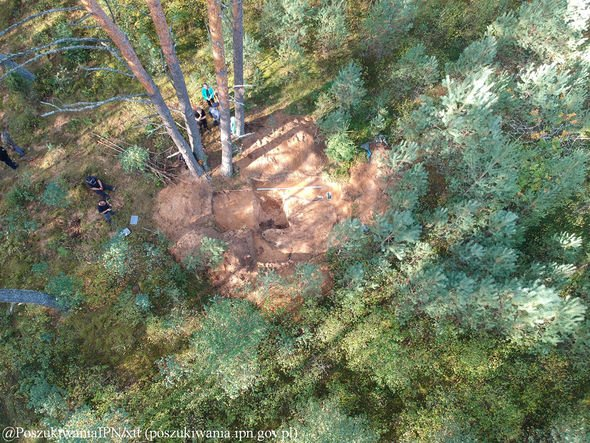
Eventually, in the fourth week of their search, they came across a mass burial pit containing at least six skeletal remains.
An initial analysis of the bodies suggests these may very well be the remains of Fakir’s unit.
The soldiers died in February 1945 in a skirmish with NKVD patrol troops.
The Soviet troops then ordered the residents of Raubiskiai to bury their remains.
One account said at the time: “They were buried in a mass grave by the road.
“After a few weeks, exhumations were to be made by the families.”
However, finding the burial pit proved a challenge after 75 years.
The fields around the Lithuanian village have grown over with forests, roads have changed and the banks of a nearby river used to identify the grave’s location have shifted.
Among the skeletal remains, the archaeologists uncovered buttons and bits of clothing.

When Nazi Germany invaded Poland from the west on September 1, 1939, the Soviet Union marched in from the east just 17 days later.
Under the terms of the German-Soviet Molotov–Ribbentrop Pact, the country was split in half.
The pact was broken in 941 with the German invasion of the Soviet Union.
After World War II ended, Poland became a Soviet satellite and the Soviet-backed Polish People’s Republic lasted from 1947 until 1989.