


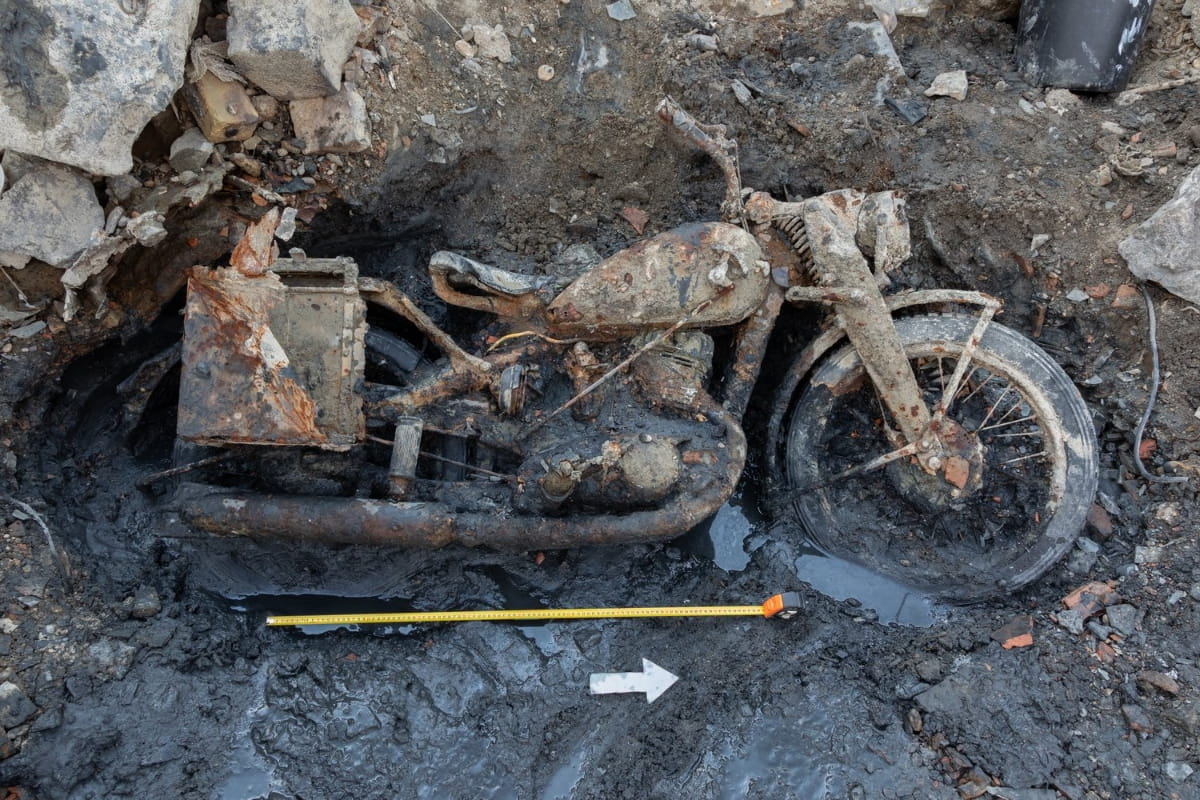

Exceptionally low water levels in the Danube have exposed the remains of two German soldiers who likely died during World War II. Their remains were found beside a German military motorcycle, identification tags, anti-tank mines, and other wartime items in Budapest.

The finds appeared on August 2 along the Buda side of the river, near the harbor at Batthyány Square and opposite the Hungarian Parliament. The exposed riverbed had been underwater for more than 80 years. High temperatures and very low water levels recently uncovered parts of the river normally hidden beneath the Danube.
Workers from Hungary’s Institute and Museum of Military History first recovered the motorcycle from the river mud. The bike is thought to be a DKW NZ 350-1, a wartime version of a motorcycle known for its sturdy design and reliability. The German army used the NZ 350-1 from 1944, when DKW developed the model for military use.
The excavation also uncovered several German Tellermine 35 anti-tank mines. Human remains were found among the wartime material, leading to further work at the site.

Gabor Kohlrusz, an exhumation worker with the German War Graves Association, recovered the remains of two soldiers on August 3 and 4. The men appear to have been German Wehrmacht troops who died during the fighting around Budapest in the final months of the war.
Their identification tags are among the most important finds. Both tags were found complete, with letters and numbers still easy to read. Each German military identification tag was designed in two parts. One half normally stayed with the dead soldier, while the other was sent to Berlin so authorities could record the death and contact the family.
The intact tags offer a possible route to identifying the two men. Their families apparently never received official news of their deaths. More than eight decades later, the records linked to the tags could help establish who the soldiers were and what happened to them.

The river mud also played a role in preserving the evidence. Kohlrusz said the mud at the site was mixed with gas oil, a petroleum product. The oily material helped protect the metal identification tags from decay while they lay in the riverbed.
Other finds included a Kuban sleeve badge and a German fuel canister. The Kuban badge was awarded to Wehrmacht soldiers who fought at the Kuban bridgehead in the Caucasus.
The discovery also points to the scale of the fighting around Budapest. German and Hungarian forces fought Soviet and Romanian troops for control of the city during the final stage of World War II. Large amounts of military gear were lost or left behind during the fighting.
The recovered soldiers will be buried at the German war cemetery in Budaörs, outside Budapest, once the examination work is complete. Further study of the remains and identification tags is expected to help clarify the men’s identities and bring long-delayed answers to their families.