


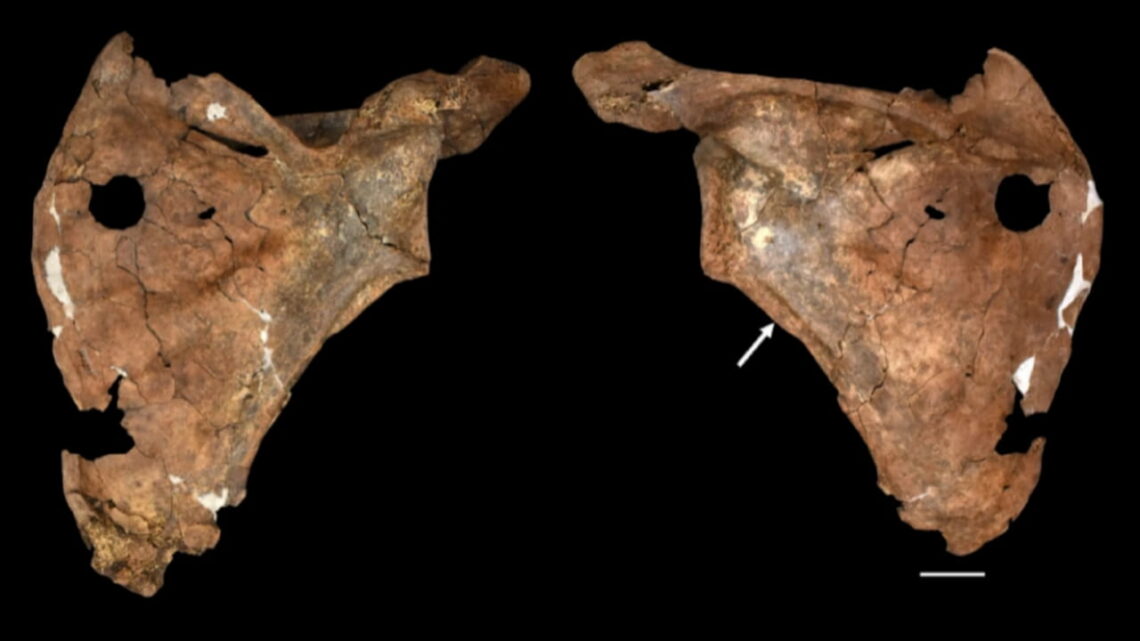

A round hole in the shoulder blade of a Neanderthal found in a cave in Iraqi Kurdistan could be the earliest known case of deadly violence with a wooden spear in the human fossil record, according to Cambridge archaeologists who published their findings in Scientific Reports.

The bone is thin enough in places to let light through, yet the remains known as Shanidar A stayed almost whole for about 75,000 years under 7.5 meters (25 feet) of rock and sediment. The only damage is a circular hole 15 millimeters wide, and the team says a sharpened wooden spear made it, since a flint or stone tip would leave a flat or angular opening.
The spear entered the left chest from the front, passed through the lung and likely major arteries, and broke through the shoulder blade, so death came fast. Beveling around the hole is typical of an exit wound, and tiny bone shards pushed out by the weapon show the spear came in from above at a downward angle. The researchers pieced part of the hole back together using those shards. They think the thrust was aimed at the heart.
Wood rarely survives from deep prehistory. Waterlogged spears from Schöningen, Germany, date to around 200,000 years ago, and some top 2 meters (6.6 feet) and were shaped for throwing, much like a modern javelin, while the oldest known rounded wooden spear, more than 400,000 years old, survives only as a pointed tip found at Clacton-on-Sea in the UK.

Lead author Dr. Emma Pomeroy says holes made by replica spears from this era match the one in the scapula, and the team says the wound could be the first evidence for sharpened wooden spears in the prehistoric Middle East.
A hunting accident is one option, since Neanderthals likely hunted big animals like mammoths up close with thrusting spears, but the position of the wound and the force needed to drive the spear through the body point to a deliberate kill. No one knows the reason for the attack or whether modern humans took part, and the simplest reading is violence between Neanderthals.

Shanidar A also shows signs of care. The team found the shoulder blade alongside a mostly complete right hand, two ribs and seven teeth, all from an adult about 45 years old. A lower front tooth had split lengthwise and the teeth beside it had rotated inward, and heavy tartar along the exposed root shows the half tooth stayed in the mouth long after a hard blow to the face. Pomeroy says living at least a year with this injury required support from other Neanderthals, who likely fed soft food.
The remains add to a burial cluster first spotted in 1960. Since 2015 the Cambridge team has found three more individuals there, bringing the total to five, four adults and an infant, packed into a space 1.5 meters (5 feet) long, 1 meter (3.3 feet) wide and 1 meter deep behind a large boulder. Shanidar A lay deepest, on the back with the head facing east, and a flash flood later disturbed the skeleton after decay. Some bodies went in before earlier ones fully decayed, so the visits came within years or decades, and Pomeroy says the best explanation is intentional, symbolic funerary behavior.