


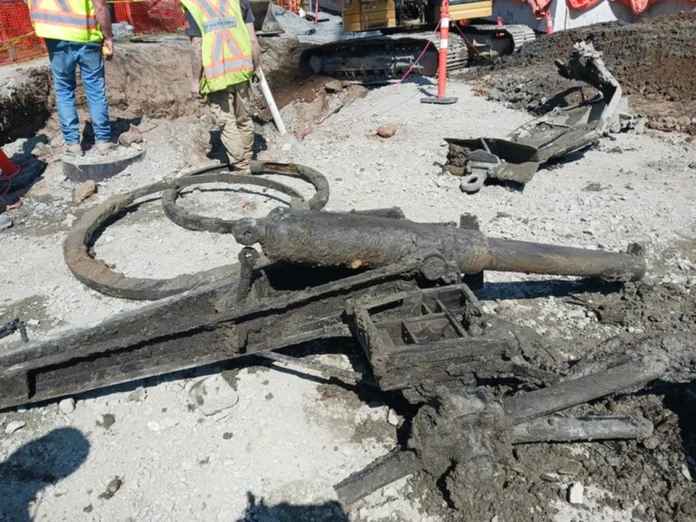

They’ve found more old military guns buried deep in the dirt on the Pacific National Exhibition grounds, including a pair of cannons from the 1870s.
The latest discoveries came during excavation for a new amphitheatre in Hastings Park, where the PNE is located.
The March 27 discovery of a rusty and decayed German howitzer from the First World War that had been buried at the PNE made international headlines.
The second find came April 23, and included two British/Canadian “nine pounder” cannons from the 1870s and four First World War German machine-guns that were brought to Canada as war trophies.
The PNE’s Laura Ballance said work crews found metal during the amphitheatre excavation, and an archeologist from the City of Vancouver and a military historian/curator from the Seaforth Highlanders museum were called in.
After doing an archeological excavation, the six military artifacts were found about three metres under the ground. The weapons were found about five metres from the previously discovered howitzer.
“The Canadian military is assessing exactly what has been located, but it appears that they were all in a line, buried beneath the ground, all at approximately the same depth,” said Ballance.
James Calhoun of the Seaforth Highlanders museum thinks the guns were all pushed into a ravine that was then filled in.
“They basically got kicked into the ravine,” said Calhoun.
“These guns were upside down in the muck. My theory is that the area where they’re building the amphitheatre used to be a high bit of ground, and there was a ravine that went down (behind it), there’s a creek that used to run through the park.”
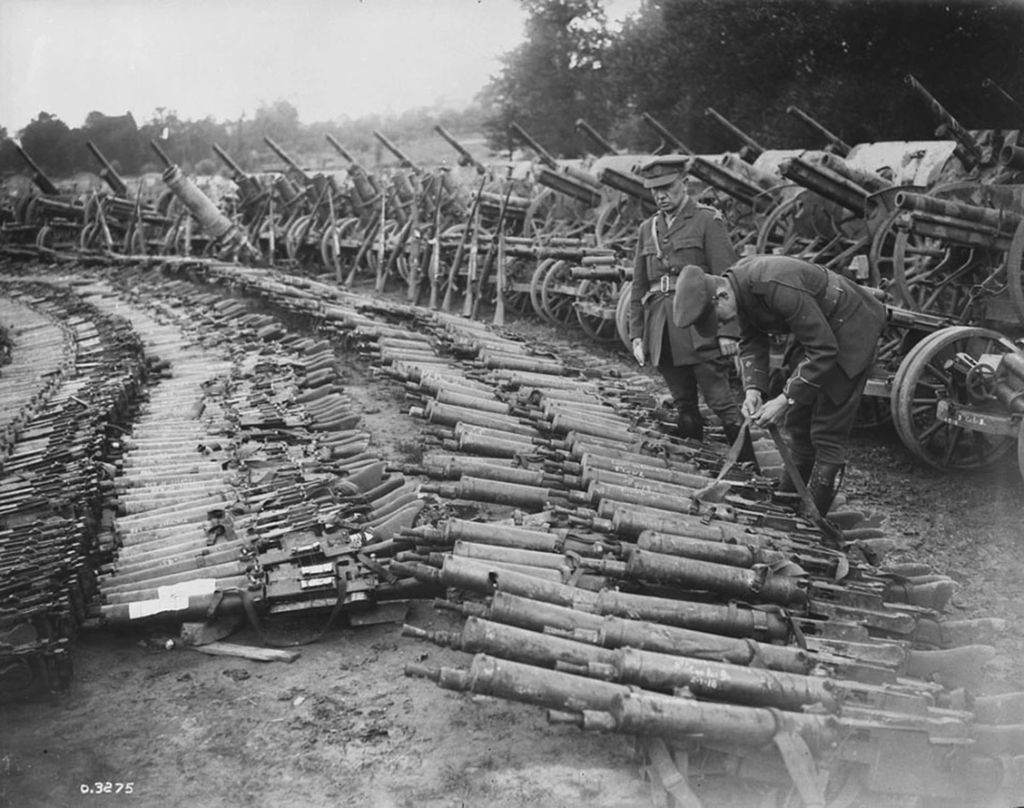
Previously, there was speculation that some First World War veterans had tried to save the German howitzer from being melted down for scrap during the Second World War by burying it.
But Calhoun said the fact all the guns were upside down probably means they were just being discarded. The military took over Hastings Park in 1942, and may have simply dumped several old weapons that were in the park.
“This was not soldiers trying to save them for posterity,” he said. “You don’t save something by pushing it over into a ravine.”
It’s something of a mystery where the 1870s cannons come from, but Calhoun has a theory.
“We might not be able to determine it precisely, but what we think the most likely source is the Esquimalt base in Victoria,” he said.
“It was turned over from the British to the Canadians in 1905, as memory serves. During the First World War, there was a unit in Vancouver called the Vancouver volunteer regiment of artillery. They were basically like the Home Guard or the reserves.
“There’s pictures of them at the Vancouver Archives and they are using guns similar to these, they’re using muzzle loading guns during the First World War. They were antiques by that point, but that’s probably all that was available.”
The machine-guns are German MG08/15s.
“We checked the serial numbers on those guns, and at least two of the guns were brought back to South Vancouver as war trophies,” he said.

Calhoun’s research shows there may be more weapons at the site.
“Potentially, if you get in there with (ground-penetrating) radar, we expect to find as many as nine more artillery pieces captured in the First World War,” said Calhoun. “Hastings Park had 10 MG08/15s machine-guns that were sent to it. Where are they? So they might be down in the hole as well.”
A 1917 map of Hastings Park shows the old creek that used to meander through the park. A couple of spots are marked “ravine” near Windermere Street, which used to go through the park.

