


Ghosts of the east: The Phantom found itself facing stiff opposition in the skies above Vietnam. Confusion over ‘kill’ claims continues to fog the picture of just how effective US air operations were in the war. Christopher Miskimon details the combats and sheds light on the bigger picture…
In November 5, 1966, two North Vietnamese MiG-21 fighters rose from their airfield to attack an American EB-66, the electronic warfare (EW) version of the Douglas B-66 Destroyer. Its role was to jam Vietnamese search radars to cover the approach of an air strike. The MiG pilots, Bui Dinh Kinh and Dong Van Song, sighted the EB-66 at 10km. They also spotted its escorts, four United States Air Force (USAF) F-4C Phantoms.
Ignoring the escorts, the two Vietnamese pilots bore in on their target. Kinh fired an R3S heat-seeking missile, a Soviet reverse-engineered copy of the American Sidewinder, an example of which was captured by the Chinese in 1958 during a clash between Taiwanese and Chinese aircraft.
The EB-66 pilot avoided the missile by performing a diving spiral into cloud. When their quarry emerged, Kinh lined up for another attack. Suddenly his MiG became uncontrollable, and he realized he had been hit. An F-4 piloted by Maj J Tuck and 1st Lt J Rabeni of the 480th Tactical Fighter Squadron (TFS) hit him with an AIM-7E Sparrow radar-guided missile. Kinh ejected as Song manoeuvred behind the F-4 to launch his own missile. As he prepared to fire, Song’s plane was hit by an AIM-9B Sidewinder from the F-4 of 1st Lts W Latham and K Klause. Song also ejected and landed safely; he would be shot down three times in 1966 but would achieve four aerial victories by the war’s end…
Armed and ready
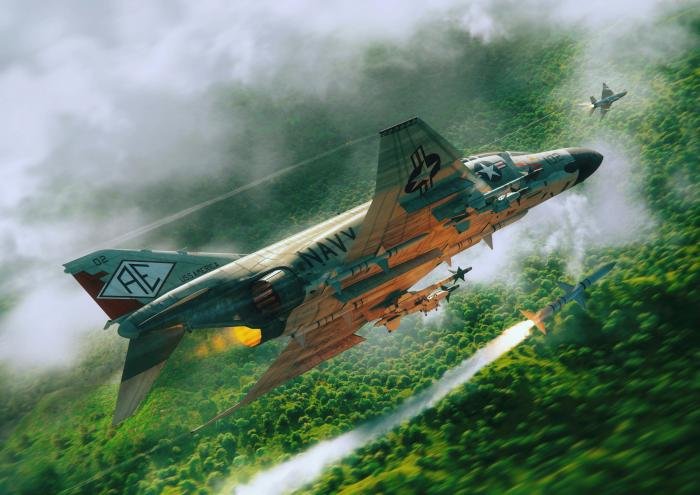
The F-4 Phantom was the dominant US air superiority fighter of the Vietnam War. Despite some limitations in manoeuvrability, pilot vision and other factors, it proved versatile and tough, able to hold its own in the skies over North Vietnam.
Like most American jet fighters developed in the 1950s, the F-4 was originally designed to intercept enemy bombers at distance during an assumed nuclear war. It was large, fast and carried a heavy missile load which it could fire at bomber formations from beyond visual range. The US Navy (USN) developed the F-4 for fleet air defence, though it could carry both conventional and nuclear air-to-ground weapons and function as a fighter-bomber.
The Phantom entered naval service in 1961 and was adopted by the United States Marine Corps (USMC) in 1962 and the USAF in 1963. In the early supersonic fighter era, American pilots were not trained in dogfighting tactics. Despite its value in the recent Korean War, dogfighting was not prioritised and the first F-4s did not carry a gun system. This was in part because of the emphasis on long range interception of enemy bombers. The prevailing thought at the time considered supersonic aircraft incapable of effectively manoeuvring. Some pilots practised on their own during training flights and many senior pilots had dogfighting experience from Korea or even World War Two.

The USN flew its first Vietnam combat missions in late 1964 while the USAF first deployed Phantoms there in 1965. They served alongside other fighter types including the USAF’s F-100 Super Sabre and F-105 Thunderchief, and the USN also flew F-8 Crusaders. While all these aircraft types are credited with air-to-air victories, the vast majority go to the F-4.
Opposing the Phantoms were the MiGs of the Vietnamese People’s Air Force (VPAF), who flew four types during the war. The Korean War-vintage MiG-15, being obsolete, saw little combat and was used mostly for training. The MiG-17 proved more useful, as it was manoeuvrable, particularly at lower altitudes. It carried 23mm and 37mm cannon. They were utilised in airfield defence and patrolling the ingress and egress routes American aircraft used. The MiG-19 entered service in late 1968, carrying two R3S Atoll missiles in addition to its three 30mm canon. The VPAF’s most effective fighter, however, was the MiG-21. It accelerated faster than an F-4 and was most effective at higher altitudes. The MiG-21 carried four Atoll missiles and a 23mm cannon. Of the VPAF’s 16 aces, three flew the MiG-17 while the rest flew MiG-21s.
Initially, F-4s did not have a gun system but were heavily armed with missiles. A typical missile load was four AIM-7 Sparrows and four AIM-9 Sidewinders. Drop tanks were often carried on other hardpoints to extend the fighter’s range. Dropping the tanks when they were still close to full could damage the fighter; many pilots elected to enter combat with the tanks still attached.
Eventually the value of a cannon became more apparent. The first encounter between Phantoms and MiGs occurred on April 9, 1965, when four USN F-4s encountered a quartet of MiG-17s while escorting strike aircraft during Operation Rolling Thunder. The engagement ended with one aircraft lost on each side. Post-action analysis revealed that of two AIM-9s and eight AIM-7s fired, only one hit its target and most malfunctioned. Due to the lack of dogfight training, the American pilots also had problems with target identification. The report noted: “There is a need for a close-in weapon as a back-up on any missile system. If an ID pass has to be made, aircraft should have a weapon to give him an immediate attack capability if the target proved hostile.”

Later in the war and beginning with the F-4E, an internal 20mm Vulcan cannon was installed. Many welcomed the new weapon, though some felt it would tempt pilots to take dangerous risks. The pilots also identified their own lack of training and the Phantom’s relatively poor agility compared to the nimbler MiGs.
American missile technology proved less effective against small, fast manoeuvring targets at close range, like the MiGs early in the war. Meanwhile, if the MiG pilot could get into a good engagement position, they could shoot down the F-4 with their cannon. USN test pilot Ronald McKeown later wrote that dogfighting in an F-4 against a MiG-17 “was like being a giant with a long rifle trapped in a phone booth with a midget using a knife.” Also, early in the war F-4s would carry bombs even when flying in an escort role, since there were other threats which might need to be attacked. The heavy bombs slowed the jets and reduced their already poor manoeuvrability.

Countering the MiGs
Even with these problems, the F-4 still had a kill ratio of 4:1 against the MiG-17 in 1965. In early 1966, however, the VPAF introduced the MiG-21, the first clash with Phantoms occurring on April 23 that year. A MiG attacked a pair of Phantoms from behind, following one into a turn. The other US jet got behind the MiG and launched six missiles, which all missed. Through the rest of the year more engagements with MiG-21s took place, but the VPAF was fighting a guerilla war in the air. Knowing they could not match the Americans in numbers or the ability to concentrate power, the North Vietnamese pilots instead attacked only when conditions seemed favourable.
The VPAF also focused on downing enemy bomber/fighter-bomber aircraft. If they could get close to a group of US strike aircraft, those pilots would often drop their bombloads prematurely to prepare to fight the MiGs. For the North Vietnamese, it was more important to prevent bombs falling on their targets than to destroy a few easily replaceable enemy fighters.
In December 1966, Col Robin Olds, a World War Two ace and commander of the 8th Tactical Fighter Wing (TFW), decided to address the growing MiG menace and planned Operation Bolo. Dozens of F-4s would simulate a strike formation of F-105s, a tempting target for MiGs. Planners believed the MiGs tended to orbit two areas near a particular airfield, waiting for incoming strike forces. Bearing in mind the MiG’s assumed fuel capacity, additional US fighters took off at intervals – this way they could attack when the MiGs were low on fuel.

Of the 92 aircraft earmarked for Bolo, 56 were Phantoms equipped for aerial combat. When the operation began on January 2, 1967, severe weather and refuelling issues meant only 32 F-4s took part. Nevertheless, by the day’s end seven MiG-21s were shot down (two more were unconfirmed) for no losses. This was nearly half the VPAF’s inventory of MiG-21s at the time. Olds stated this showed the F-4 could deal with MiG-21s from 8,000 to 12,000ft, saying: “You’ve got a good fight on your hands, but you can hack a MiG-21.” It was the largest single fight with MiGs during the war.
Considering tactics
As the war continued the MiGs increased their aggressive tactics, and it became increasingly difficult to target them effectively. MiG-17s and 21s often operated in groups, with the MiG-17s acting as either cover or bait while the more potent aircraft made attacks. When possible VPAF pilots attacked from behind to increase their chances. Soon the kill ratio fell to almost 1:1 and more American planes had to be reassigned from strike to combat air patrol. The VPAF was innovating and adjusting its tactics faster than the USAF and USN.
The bombing of North Vietnamese targets stopped in late 1968, part of a political move designed to lure North Vietnam to the negotiating table. Bombing resumed in 1972 when talks were stalled, the idea being that a punishing air assault might bring the North back to the table. During the lull, both the USN and USAF studied the situation to see how they might be ready when and if bombing began again.

In the eyes of the air force, there was no crisis. Along with the USN, the best pilots were assigned to fighter and attack aircraft, while the rest went to large multi-engine aircraft.
However, the bomber-focused USAF of the 1960s started to question this idea, believing any trained pilot could fly any type of aircraft. Many pilots assigned to fly Phantoms in Vietnam consequently had no actual experience flying the aircraft. Some had never even seen a fully loaded F-4 until they arrived in Thailand. The Phantom had a crew of two, a pilot and Weapon System Officer (WSO), often referred to as the GIB (Guy in Back). In the USAF, these two officers were not habitually assigned together, making it harder to develop a good working relationship.

Instead, the USAF sought improvements in weapons systems and the aircraft itself. This included new targeting and computing systems that decreased the pilot’s workload. It also made improvements to the AIM-7 missile, though changes to the AIM-9 had made no impact on its performance. Both services also studied MiGs acquired though clandestine purchase or defecting pilots.
The USN took a different approach, deciding to improve the training of its pilots. In 1969 it opened the Naval Fighter Weapons School (NFWS), known popularly as ‘Top Gun’. The school aimed to train naval aviators in the tactics needed to defeat MiGs. Its instructors also flew the F-4 extensively, to learn the limits of its performance. They discovered many things about the F-4 and passed these techniques to their students.
Fog of war
When American strike missions returned to North Vietnam in 1972, USAF Phantoms initially suffered even worse losses as ‘improvements’ to the jets proved inadequate. An improved ground-controlled intercept system code-named Teaball was successfully introduced. Navy pilots fared much better due to their new training, though they also benefitted from better ground control and communications jamming which separated VPAF pilots from their own controllers. In one attack on Haiphong harbour, Navy F-4s downed eight MiGs for three losses. One F-4 pilot, Lt Randy Cunningham, shot down three MiGs in this engagement, becoming the first ace of the war.

The last engagement between F-4s and MiGs occurred on January 12, 1973, when two USN Phantoms from USS Midway were vectored against a MiG-17. The VPAF pilot, Luu Kim Ngo, spotted the approaching Phantoms and rolled behind the Americans. Inexplicably, he then made another turn which put him within firing range of the F-4s. USN Lt Victor Kovaleski fired two Sidewinders, destroying the MiG. Ngo did not survive.
For both American and VPAF pilots many factors contributed to success or failure, including training, experience, weapons effectiveness, ground control and intelligence. It was more than just pilots facing off from their respective cockpits. Which side was most effective?
Arguments over kill ratios in Vietnam persist to this day. Most, except those claimed by the VPAF, place the ratio in the American’s favour and this was certainly true over the course of the war. Depending on which statistics are accepted, that ratio could vary from 2:1 to the 15:1 reported during the use of Teaball. Sometimes the ratios are divided into phases of the war and those often appear more accurate. An overall ratio for the war, however, remains elusive.
It may be more instructive to consider what each force was trying to accomplish. The Americans wanted to strike ground targets within North Vietnam; destroying the MiGs which threatened those strike missions was a necessary part of that goal. In this they were successful. An estimated 197 MiGs were shot down during the Vietnam War, with 150.5 claimed by Phantoms. Lost fighters were quickly replaced, but it is notable that according to USAF sources, the VPAF’s greatest MiG strength was 206 aircraft in May 1972.
From 1964-67 the number varied but never exceeded 100. Only a portion of these would have been operational at any one time. From these numbers it can be determined that US efforts did achieve success, and the F-4 was by far its most successful fighter.

For the Vietnamese, their claims of numbers of F-4s downed are much higher than the 40 aircraft US sources confirm as lost to MiGs. Given the VPAF’s goal of preventing successful bombing attacks, however, it is notable that of American strike missions which encountered MiGs, 55% were prevented from engaging their targets. For example, in December 1966, 20% of the US strikes in the Hanoi area dropped their ordnance prior to reaching their targets, due to MiG intercepts. While there were never enough MiGs to affect more than a small percentage of American attacks, they did have an effect.
Perhaps the best conclusion is that while the USAF and USN had the upper hand in air-to-air combat, it was but one facet of aerial operations in a large and complex air war.