


The Lockheed P-38 Lightning was one of the most successful fighters of World War II and saw service in every major theater of the conflict. The P-38, easily recognizable for its distinctive twin-boom design, was loved by the pilots who flew it, and it became one of the most produced fighters of the war.
Today, around ten P-38s are airworthy, mostly in the United States. Only around 3% of the Lightning’s production output still exists today, and many of these have been extensively rebuilt, with some having been trapped in ice for half a century. The Lightning is one of the most loved fighters of the Second World War and is one of the stars of vintage airshows across the country.
One Of The Second World War’s Most Successful Fighters
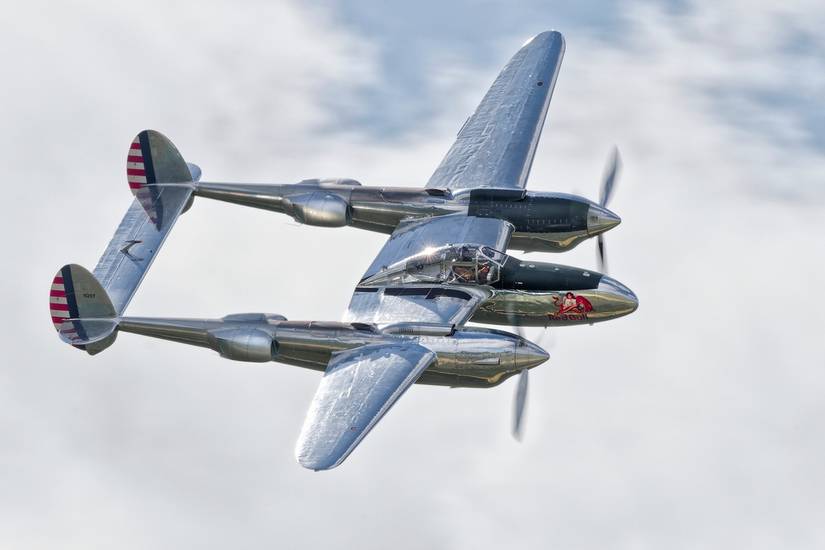
Among the P-38’s many attributes is that it was one of the most versatile fighter aircraft. Its roles included those of a fighter-bomber, a night fighter, a long-range escort fighter, a bomber pathfinder, and aerial reconnaissance. Notably, in Europe, the type accounted for around 90% of the American aerial film taken, while in the Pacific Theater, it was highly valued for its long range.
The Lockheed P-38 Lightning featured a distinctive twin-boom design with a central nacelle that housed the aircraft’s cockpit and armament. Unlike some heavy German fighters of the time, the P-38 was only crewed by a single pilot. Despite its large size, the aircraft still had enough agility to compete with the period’s single-engined fighters.
One of the most enduring legacies of the Lightning is its aerial combat record. It boasted the United States’ top aces, including Richard Bong with 40 victories, Thomas McGuire with 38 victories, and Charles H. MacDonald with 27 victories. It has the distinction of being the only American fighter aircraft to have large-scale production throughout the US participation in the Second World War, and, by the time production ended with the end of the conflict, 10,037 P-38s had been produced.
Retirement & Scrapping
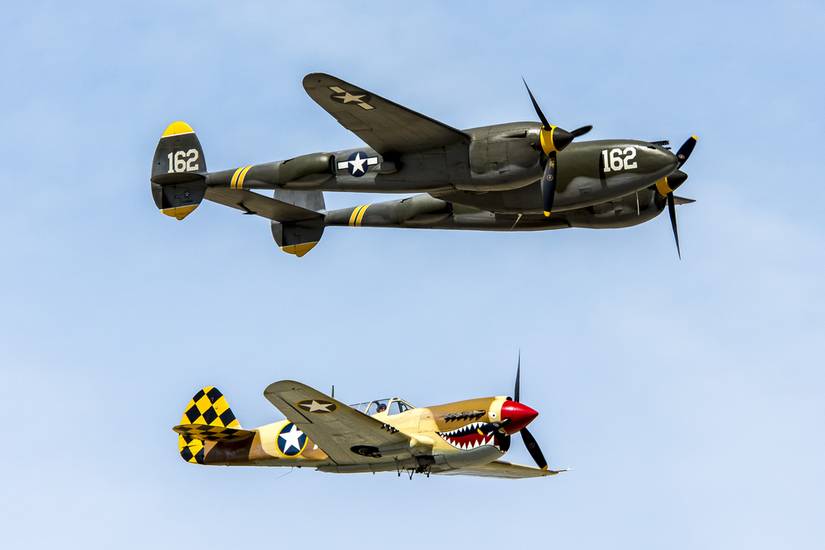
By the time the war ended, the era of jet fighters had dawned. The Germans and British already had fighter jets in combat use while the United States was testing out its first jet fighter, the Lockheed P-80 Shooting Star. Production ended in 1945 as the conflict came to a conclusion, but the P-38s were not retired immediately. The United States continued operating them until 1949, with other countries operating them into the 1950s and even the 1960s.
Limited numbers were operated by Australia, Canada, Nationalist China, Free France, post-war Italy, and others. Italy held onto its P-38s longer than many, phasing them out in 1956. Unfortunately, all Italian P-38s were recycled after retirement to retrieve their valuable light alloys. It seems the final holdout for the P-38 became Honduras in Latin America. Honduras operated a limited number of Lightnings between 1948 and 1969 when they were exchanged for F4U-4 Corsairs.
| Lockheed P-38 Lightning | |
|---|---|
| Builder | Lockheed Corporation |
| Dates built | 1941–45 |
| Number built | 10,037 |
| Retired | 1949 (USA) |
| Number flying | Approximately 10 |
| Number in existence | Approximately 26 |
Widely exported aircraft have the benefit of being preserved. If one country chooses to scrap and recycle all of its aircraft of a particular type, another country may choose to preserve them and place them in museums.
Fewer Than 10 Examples Are Still Flying Today
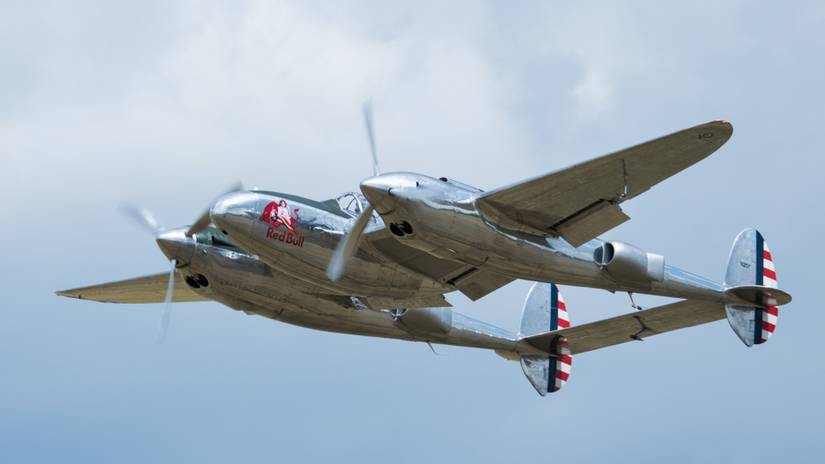
According to Classic Aircraft Sales, there are fewer than 10 P-38 Lightnings flying today around the world. This is corroborated by the P-38 National Association & Museum, which said in March 2018 that there were nine P-38s not only flying, but also participating in air shows around the world. Most of the survivors are not airworthy and are found in museums around the world.
Overall, it is believed that around 26 of the 10,037 Lightnings built survive today. Of these, 22 are located in the United States and four are located in other countries. The number of flightworthy aircraft and even aircraft in existence can change over time. It is possible to restore even badly damaged aircraft, although this is matter of many work hours, custom engineering a whole load of parts and components.
There are possibly more P-38s lost in the ice or jungles that could one day be retrieved, restored, and flown. For example, a Douglas A-50 Havoc bomber was recovered from the jungles of Papua New Guinea and placed on display in that country. According to NBC, it was fully restored just in time for the country’s 50th Independence Anniversary from Australia. Various P-38s are reported to be currently or recently under restoration in Australia, Serbia, the United Kingdom, and the United States.
Non-California US Flying P-38s
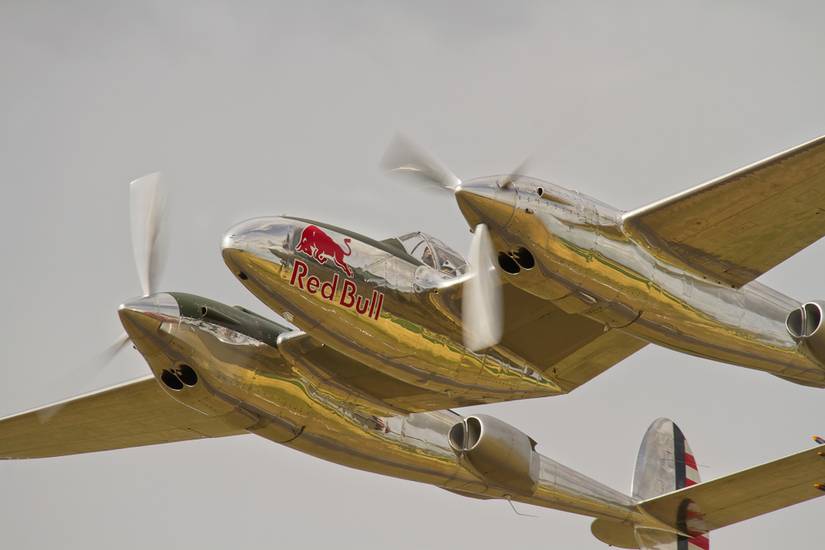
Airworthy P-38s in the United States include one serial numbered 42-12652 (registered N12652) near Colorado Springs. It was recovered in Papua New Guinea and restored. Another, registered 44-53097 (NL3JB), is found at the Museum of Flight in Seattle. The Fagen Fighters WWII Museum in Minnesota has a flying P-38 with the serial number 44-27231 and registration number N79123. A P-38 can also be found in Oregon in flying condition (serial number 44-27083 and registration N2114L).
Going to New Mexico, visitors can see another airworthy War Eagles Museum at Santa Teresa. That P-38 (serial number 44-27053, registration N577JB). It should be noted that vintage aircraft like the P-38 are sometimes re-registered and sold to other collectors. That said, the aircraft’s serial number doesn’t change, making it easier to track the aircraft.
| P-38 reportedly airworthy | Location | State/Country | Registration |
|---|---|---|---|
| “White 33” serial #42-12652 | Feenix Partners | Colorado | N12652 |
| “Lizzie” serial #44-53097 | Museum of Flight | Washington | NL3JB |
| “Scat III” #44-27231 | Fagen Fighters WWII Museum | Minnesota | N79123 |
| “Tangerine” #44-27083 | Tillamook Air Museum | Oregon | N2114L |
| “Relampago” #44-27053 | War Eagles Museum | New Mexico | N577JB |
| “Glacier Girl” #41-7630 | Lewis Air Legends | Texas | N17630 |
| “Thoughts of Midnite” #44-53095 | Owned by Charles Somers | California | N9005R |
| #44-26981 | Vintage Fighters LLC | Unclear, formerly California | N7723C |
| “Collings” #44-53186 | The Collings Foundation | Massachusetts | N505MH |
| #44-27183 | Yanks Air Museum | California | N718 |
| “23 Skidoo” #44-23314 | Planes of Fame Museum | California | N138AM |
| “Red Bull” serial #44-53254 | Salzburg Airport | Austria | N25Y |
Lewis Air Legends in San Antonio, Texas, boasts a flying P-38 that was retrieved after being buried under the Arctic ice for 50 years. She was finally pulled out of the ice piece by piece, restored, and christened “Glacier Girl.” The Collings Foundation in Stow, Massachusetts, has another (serial number 44-53186 and registered N505MH), which has participated in air shows in recent years.
Californian & Foreign Flying P-38s
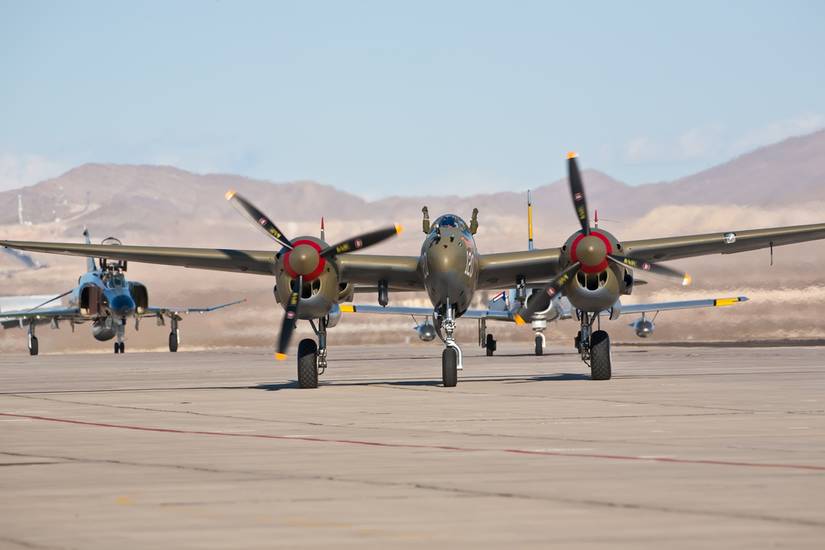
It appears that California has the most flightworthy P-38s, with perhaps three in flying condition, two of which are in Chino. One (serial number 44-23314 and registered N138AM) is found in the Planes of Fame Museum in Chino, California. Another has the serial number 44-53095 (registered N9005R), and another is also in Chino and has the serial number 44-26981 and registration number N7723C, although it is unclear if the latter is airworthy.
The Yanks Air Museum has another example (serial number 44-27183, reg. N718). It is unclear if this aircraft is just on static display or if it is also airworthy. Yanks Air Museum suffered a fatal crash in 2024 with a Lockheed Electra 12A near Chino. Outside of the United States, Austria is also home to a rare flying P-38 Lightning. That aircraft, registered N25Y, is owned by the Flying Bulls. It is housed in Hangar-7 in Salzburg, and was restored to airworthiness in Texas in 2008.
There were reports in 2021 that Australia (including HARS’s workshop) was restoring P-38s. It is unclear if any of these are now flightworthy. There is reportedly a P-38 (serial number 44-25786) in Serbia’s Museum of Aviation in storage that could be restored. Another Lightning with the serial number 42-66841 “Scarlet Scourge,” was shipped to the United Kingdom a decade ago. It was reported that the aircraft would be restored to airworthiness in the UK.
More P-38s On Static Display
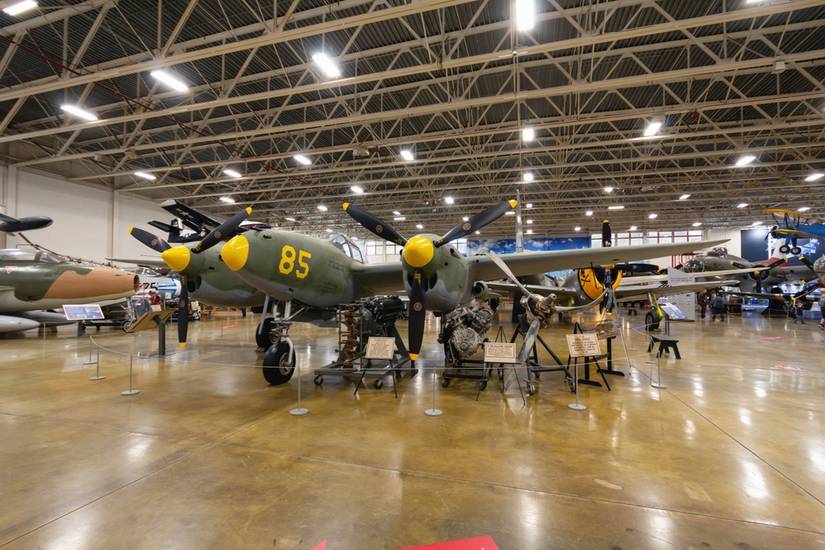
Many of the Lockheed P-38 Lightnings flying around the world are extensively rebuilt. Oddly enough, some of today’s flying P-38s are not retired fighters that survived the Second World War. Instead, they are lost fighters who survived by crashing into the ice or jungle. While crashing obviously caused extensive airframe damage, it also had the effect of preserving them from the recyclers.
Besides the P-38s that are in some sort of flying condition, more can be found on static display at museums and air force bases across the country. Examples include the National Air & Space Museum in Washington, D.C., the National Museum of the USAF in Ohio, the Experimental Aircraft Association in Wisconsin, Elmendorf Air Force Base in Alaska, on the Tom McGuire Memorial Joint Base in New Jersey, and the Hill Aerospace Museum Air Force Base in Utah.
The number of existing aircraft is unclear because some examples may not be complete, such as a P-38 with a partial body on display at the Fantasy of Flight Museum in Florida. When it comes to flightworthiness, some aircraft may have been restored to flyable condition, but that doesn’t mean that they do fly in practice or will even ever fly again. More examples are known to be in the process of restoration, but the status and funding of those projects are not widely reported.