


Archaeologists have recently discovered the remains of a woman believed to date to the Iron Age inside an unusual stone-lined structure. The site was found near a quarry in Sutherland in northern Scotland. The structure and surrounding features are provisionally considered Iron Age, while the feature may be about 2,000 years old; direct dating and further analysis are still pending. Given the considerable effort that went into constructing the structure in which she was eventually buried, researchers are questioning who she was, what role she held within her community, and why her remains were deposited there.
A Remarkably Well-Built Iron Age Burial
Highland Archaeological Services Ltd (HAS) made the find while carrying out work on behalf of local quarry firm GF Job ahead of a planned expansion of its Evelix quarry near Dornoch. HAS reports that further analysis is still needed and will take several more months to learn as much as possible about this Iron Age woman and the “pit” she was buried in.
The site was discovered at the possible site of Iron Age roundhouses, given the remaining evidence of holes in the ground that could have held timber posts used in the houses’ construction. In 2023, archaeologists investigated the nearby Camore Wood prehistoric settlement, where at least 20 hut circles have been identified. Radiocarbon dating from one excavated roundhouse revealed occupation during both the Middle Bronze Age and Middle Iron Age. The archaeologists were impressed with the expertise of the pit’s builders. It was dug into the sand and measured about 10ft (3m) long, 6.5ft (2m) wide, and 3ft (1m) deep, with a small stone staircase descending into the structure.

A Burial So Well Built Archaeologists Thought It Was Modern
A HAS spokesman notes that researchers believed, at first, that they had found a modern grave site:
“Tucked into one corner of this beautifully made structure were discovered the remains of an individual who is thought to have lain undisturbed since the Iron Age.”
Archaeologist Lynne McKeggie, director of HAS, pointed out the contrast between the tomb’s appearance and the human remains that it held:
“When site staff first saw the pit and how well the lining was built, they thought it might be modern, but the finds inside, and this style of building all point to the Iron Age date.”

A Mysterious Structure Unlike Anything Seen Before
According to McKeggie, the structure’s original purpose is a mystery, noting the stones appeared expertly fitted, while the official record describes viscous, clay-like bonding in the lower levels. She speculated that one wall stone had once served as a mortar or perhaps grinder base, bearing a distinctive hollow worn into it before being incorporated into the structure. McKeggie made clear that her team didn’t believe that the pit was originally intended to be a burial site. The burial was likely done well after its original construction. The team had not seen a burial site with these unusual characteristics: “It is a bit of a mystery. No one has seen anything like it before,” she commented, adding that it bore some semblance to a ritual well but didn’t conform to the usual shape of one.
Archaeologists Race to Record the Structure Before its Removal
HAS explored whether the stone-lined structure could be preserved in situ at the quarry site, but concluded that exposure to weather conditions after many millennia safely underground would lead to its deterioration and collapse. Instead, the research team carried out an intensive excavation, documenting the pit in thorough detail with notes, drawings, photos, and maps before finally removing its contents. According to McKeggie, the skeleton showed notable dental characteristics, including an underbite and heavily worn front teeth.
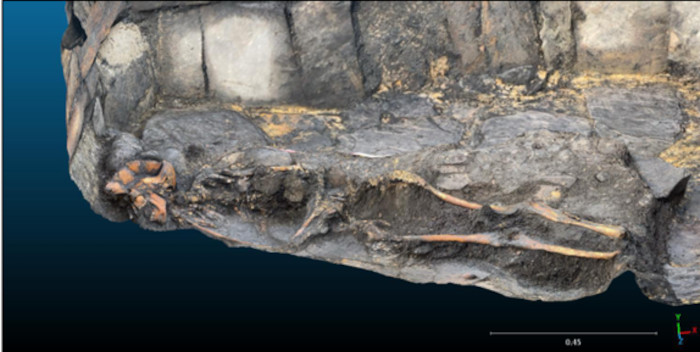
3D Scans Preserve the Burial in Remarkable Detail
A small soapstone bowl and a substantial quantity of animal bone were also recovered from the structure. HAS also recovered a large quantity of animal bones at the site. The pit was recorded with photographs and 3D scans. Information about the site is now part of the database of the Highland Historic Environment Record. The quarry company, GF Job Ltd, is financing further analysis of the human remains.
Forensic Analysis Could Reveal the Woman’s Final Secrets
Specialists in forensic anthropology will examine the remains to estimate the woman’s age at death and investigate her health, physical characteristics, and any evidence that might shed light on the circumstances of her death.