


A Stranger in Ellora
The journey to Ellora had been long, but as I approached the fabled Kailasa Temple, my fatigue melted away, replaced by sheer awe. As an architect from a neighbouring kingdom, accustomed to designing grand palaces and temples, nothing could have prepared me for this sight.
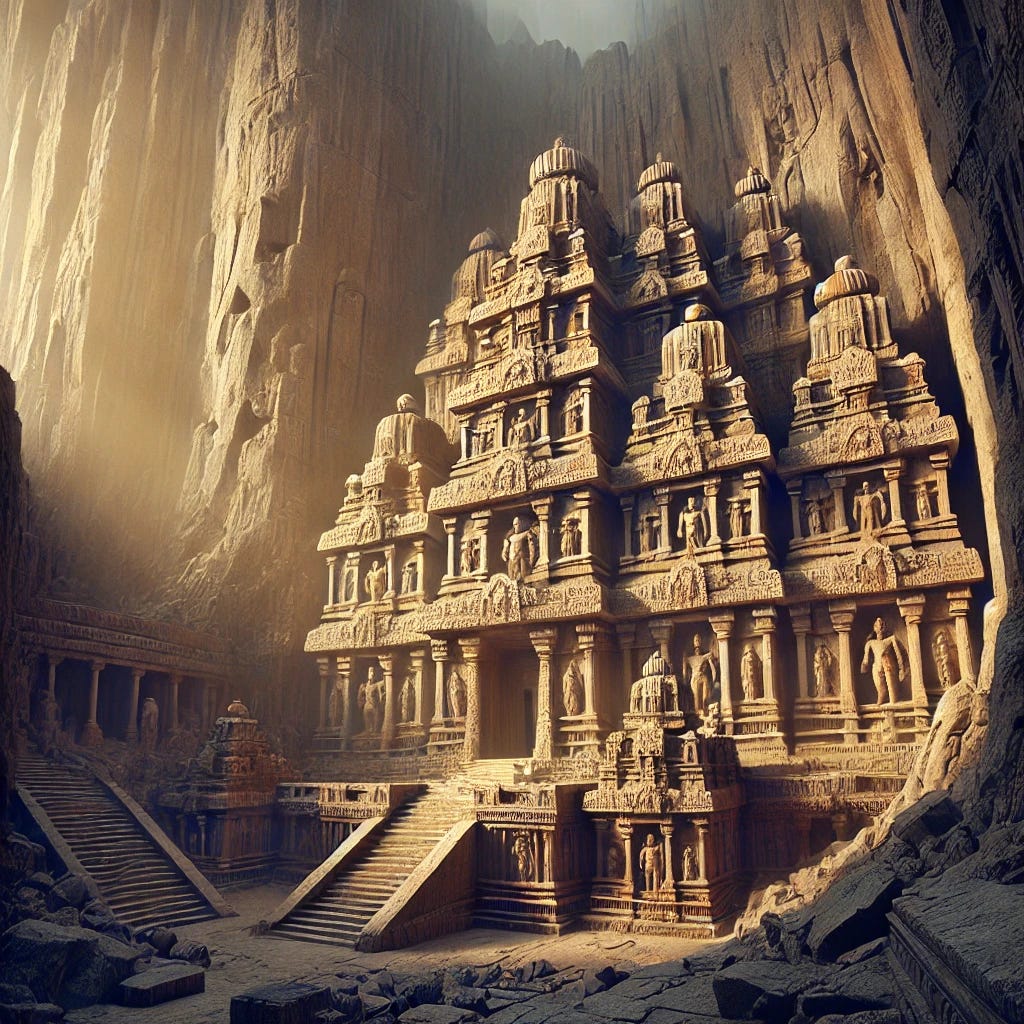
Towering before me was a monolithic wonder carved directly from the side of a mountain. Entirely hewn from a single, continuous rock, the Kailasa Temple was not just architecture; it was an audacious act of devotion and a declaration of human ambition.
I stood at its base, my neck craning upward, tracing the structure that seemed to grow organically from the earth itself.
How did artisans shape such a grand temple from raw cliffside rock, removing hundreds of thousands of tons of stone with rudimentary tools?
These questions flooded my mind, and they continue to challenge historians, architects, and archaeologists to this day.
Walking Through the Temple:
A Personal Journey
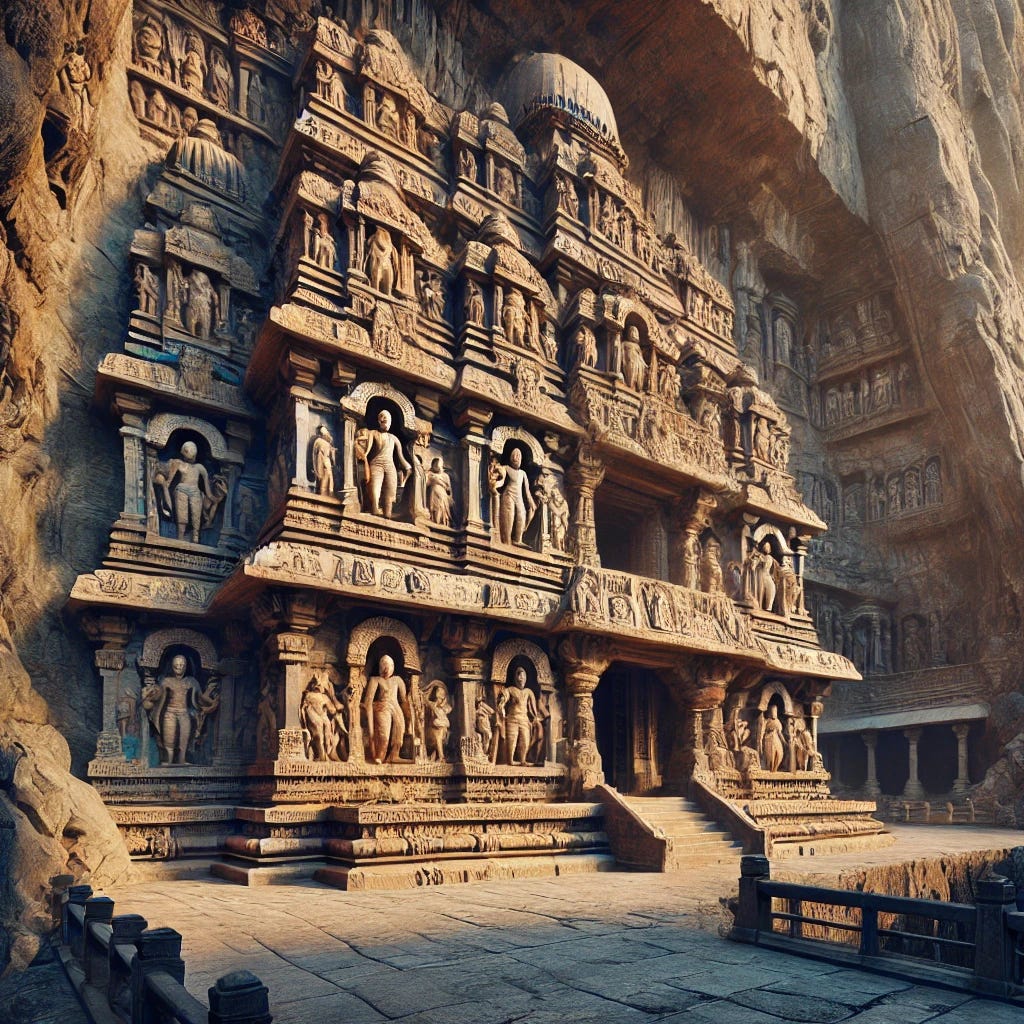
I stepped closer, the rough-hewn steps beneath my feet a testament to the relentless labour that had shaped this marvel. Wandering through the courtyards, my fingers brushed over intricately carved pillars, the stone cool beneath my touch.
Each corner of the temple was alive with carvings — gods, goddesses, mythical creatures, and floral patterns — each etched with such precision that I marvelled at the skill of their creators.
The inner sanctum was a vast space, its ceilings towering above, and the echoes of my footsteps lingered as if reluctant to fade away.
How could such precise and delicate carvings have been achieved in these dim interiors, using nothing but oil lamps?
The sheer scale and intricate detail left me wondering — was this truly possible with only hammers, chisels, and basic tools?
A Modern Perspective:
Lost Technology or Human Perseverance?
Years later, sitting in a modern office, I found myself revisiting my memories of Kailasa. To understand the mystery better, I reached out to Dr Arjun Patel, an independent researcher who believes that the Kailasa Temple might be evidence of lost, advanced technology.
Dr Patel, leaning forward, his eyes alight with enthusiasm, began…
Imagine this, the builders of Kailasa removed over 400,000 tons of rock. If we think about the tools they had available — bronze chisels and hammers — it’s hard to fathom how they achieved such precision.
There are some theories, wild perhaps, but intriguing: sonic drilling, unknown machinery, perhaps even extraterrestrial assistance. It’s as if they had access to technology that’s simply vanished from our historical record.
Dr Patel spoke of advanced vibrations, of methods that might not align with our conventional understanding of history — ideas that often border on science fiction. Standing there at Kailasa, feeling dwarfed by its grandeur, it was difficult to dismiss his fervor entirely.
Could we be missing something, an ancient technological marvel lost to time?
The Skeptic’s Case:
Celebrating Human Ingenuity
To balance Dr Patel’s theories, I consulted Dr Meera Rao, a respected archaeologist specialising in ancient Indian architecture. Unlike Dr Patel, Dr Rao was convinced that the Kailasa Temple was a testament to human perseverance, ingenuity, and sheer determination — a feat of immense labour, perhaps spanning generations.
Dr Rao explained…
We have to understand the cultural context, The Kailasa Temple was built during the Rashtrakuta dynasty, a period of considerable resources and ambition.
This was not a solitary endeavour — it was the work of thousands of artisans, labourers, and planners, supported by a powerful empire. The workers started carving from the top of the mountain and worked their way down — a top-down construction approach.
The workers organised themselves meticulously, and their tools, though simple, were incredibly effective when used with patience and skill.
She paused, smiling as if picturing the bustling site.
Think of the rock-hewn churches of Lalibela in Ethiopia, carved in a similar manner, or even the Petra complex in Jordan.
We tend to underestimate ancient civilisations, but the Kailasa Temple is proof of what the human spirit can achieve with time and devotion.
Engineering the Impossible
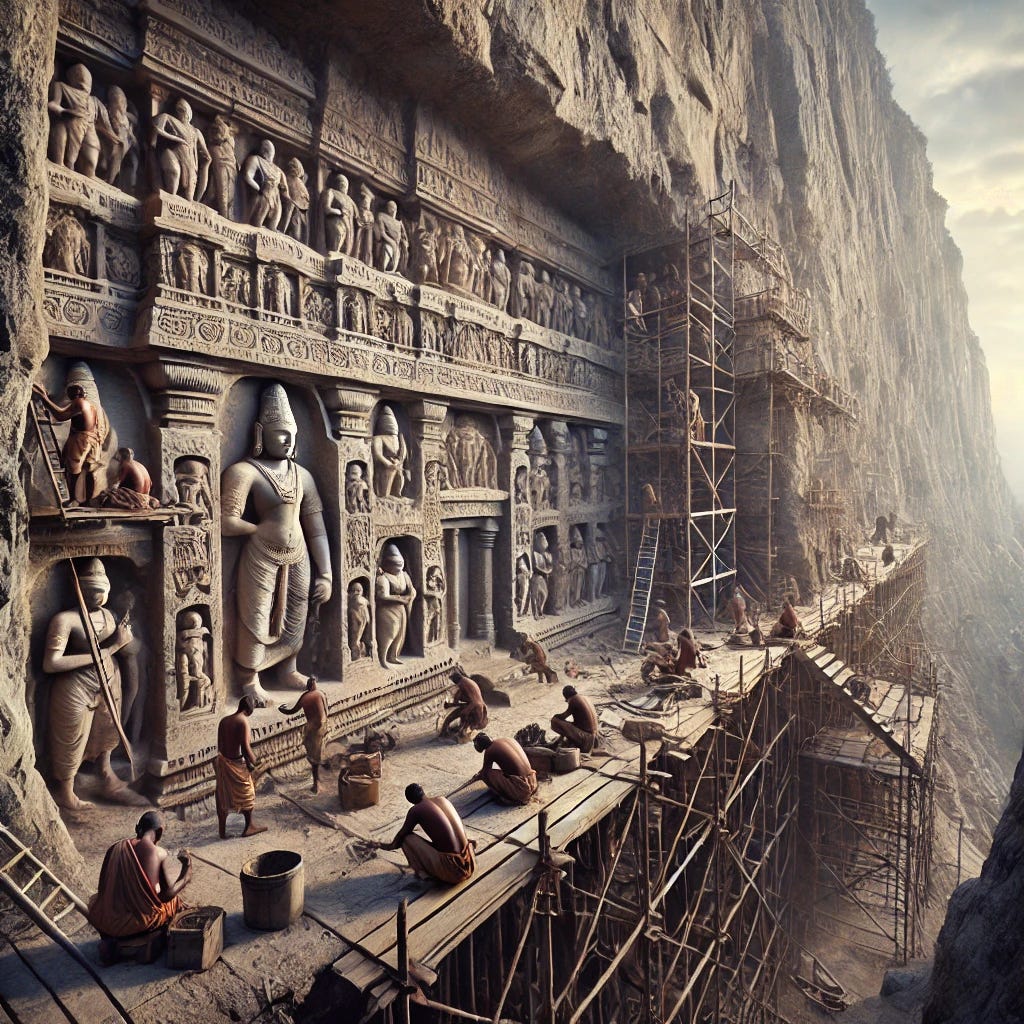
How did they carve such an immense temple from a single rock?
Theories abound, each with its merits and challenges. Some experts argue that the builders first outlined the shape, then systematically removed massive amounts of rock, working from the top down.
The removal of stone alone would have required precise coordination — moving massive chunks of basalt, managing waste, and ensuring worker safety. The temple’s alignment, its proportions, and its intricate carvings suggest a level of planning that rivals modern construction techniques.
Sacred Geometry and the Spiritual Vision
Sacred Symbolism and Mount Kailash
One aspect often overlooked amidst the technological debates is the sacred symbolism embedded in the temple’s design. Kailasa is believed to represent Mount Kailash, the mythical abode of Lord Shiva, a place of immense spiritual power and significance in Hindu cosmology.
Mount Kailash is considered the center of the universe and is believed to be the axis mundi — the cosmic axis that connects heaven and earth. For Hindus, it is a place where the physical and spiritual worlds intersect, and it is revered as the ultimate destination for those seeking enlightenment.
The mountain’s sacredness also extends to other religions, including Buddhism and Jainism, further highlighting its profound spiritual importance. The temple was intended to reflect the divine nature of this sacred mountain, serving as an earthly manifestation of the spiritual realm.
Sacred Geometry in Design
The layout is steeped in sacred geometry, creating a spiritual resonance that many devotees feel even today.
Sacred geometry involves the use of specific ratios and shapes believed to reflect the fundamental design of the universe. The golden ratio, a mathematical ratio often found in nature, is thought to create aesthetically pleasing and harmonious proportions. Mandalas, intricate geometric designs symbolising the universe, are used to represent wholeness and spiritual balance.
The builders of Kailasa incorporated elements like the golden ratio and mandalas to create a sense of balance and harmony that is felt intuitively. The temple’s proportions align with natural laws, perhaps even channeling cosmic energy into the structure. This use of geometry was not simply for aesthetics — it was meant to create a space where physical and spiritual realms could converge seamlessly.
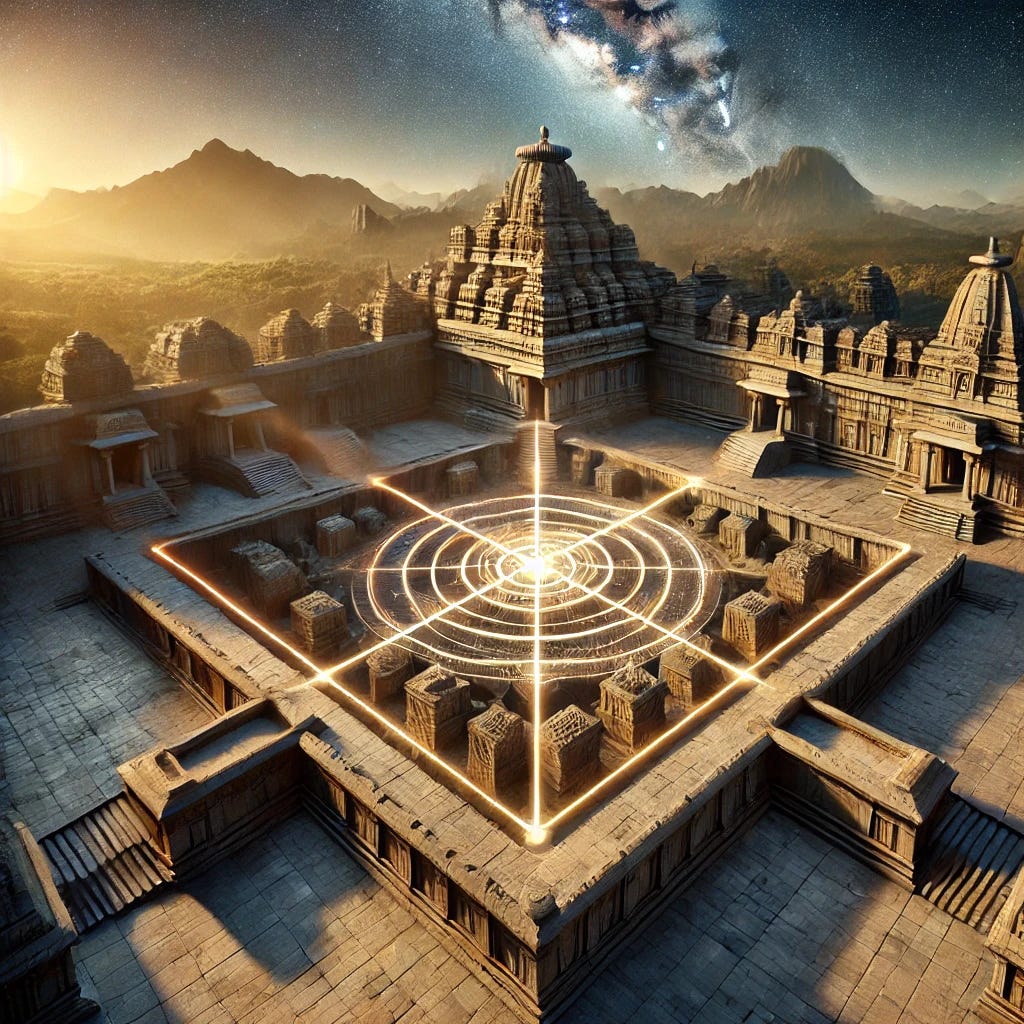
The Cosmic Diagram
The temple is not just a physical marvel; it is a symbol of devotion, a cosmic diagram linking the material to the divine. This ‘cosmic diagram’ is represented in the temple’s physical features through its geometric layout, alignment with celestial bodies, and the use of sacred ratios.
Each design element — from the placement of courtyards to the proportions of the central shrine — embodies cosmic harmony, linking every stone to a larger universal order. The geometry adds to its mystery and purpose, allowing the structure to function as more than a place of worship — it becomes a conduit for spiritual energy.
Many design elements, such as the towering vimana (spire), symbolize the connection between earth and sky, reinforcing the idea of ascension and the journey toward enlightenment. The verticality of the temple evokes Mount Kailash itself, suggesting a profound symbolic journey for worshippers from the mundane to the divine.
Mandalas and Axis Mundi
The entire temple complex can be viewed as a three-dimensional mandala, a sacred diagram representing the universe. The central shrine acts as the focal point, often interpreted as the axis mundi — the central axis connecting heaven and earth. The concept of the axis mundi is prevalent in many cultures; it is often seen as the world tree or cosmic pillar that maintains the connection between different realms.
In Hindu tradition, Mount Kailash is viewed as such a pillar, but similar ideas can be found in Norse mythology with Yggdrasil, the world tree, or in ancient Mesopotamian ziggurats, which were believed to connect the heavens, earth, and underworld.
This universal symbolism reinforces the idea of the Kailasa Temple as a meeting point between the human and the divine, reflecting a broader cultural understanding of sacred centers. The symmetry and precision found in the temple’s architecture further reinforce this symbolism. The artisans employed advanced mathematical principles, including Vedic mathematics, to create spaces imbued with sacred meaning and proportions that resonate deeply within the observer.
Knowledge and Craftsmanship
It is remarkable that the artisans grasped these advanced concepts of space and proportion so thoroughly. Whether this knowledge came from oral traditions, sacred texts like the Vedas and Puranas, or was honed through centuries of experiential learning, the result is a structure that not only stands as an architectural wonder but also serves as a spiritual beacon.
The careful alignment of the temple with cardinal directions, its astronomical markers, and the integration of sacred geometry ensured that every aspect of Kailasa had a divine purpose, turning stone into a living testament of cosmic balance and spiritual elevation.
A Sculptor’s Story
Imagine being one of the sculptors on this grand project. The year is 760 CE, and you are one of many craftsmen gathered from across the region. Each morning, you rise with the sun, your hands already calloused from the labour of carving.
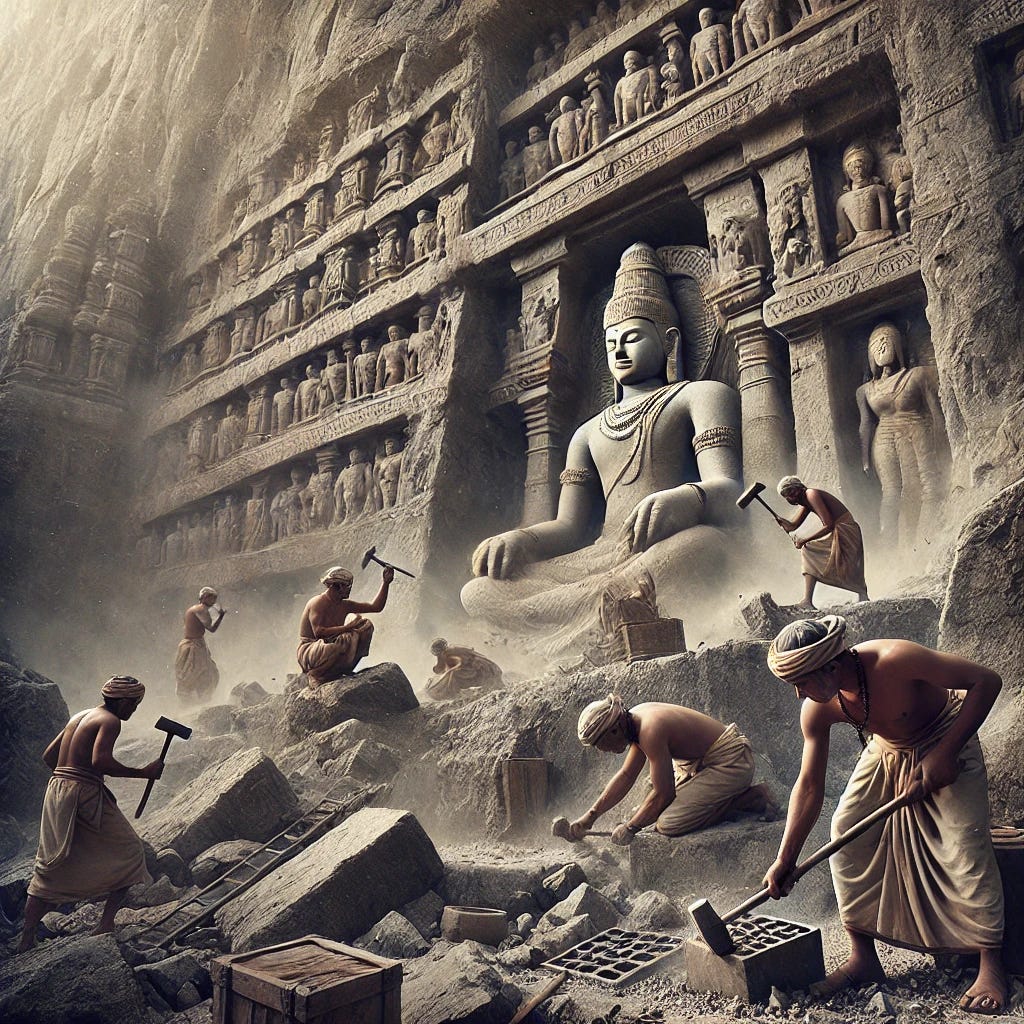
You approach the mountain, tools slung over your shoulder. There is an energy in the air — a feeling that you are part of something far greater than yourself. You know that this temple will be your legacy. Long after you are gone, pilgrims will come here and marvel at what you and your fellow craftsmen have created.
Perhaps you even feel that divine forces guide your hand, each strike of the chisel blessed by Lord Shiva himself.
Conclusion:
Mystery or Mastery?
Where does that leave us?
The skeptics argue for human perseverance, human sweat, and human genius. The believers in lost technology see anomalies that modern science struggles to explain.
Perhaps the truth lies somewhere in between. Maybe we underestimate our ancestors, or maybe they had ways of knowing — and doing — that we have yet to rediscover. What is certain, however, is that the Kailasa Temple stands as a monumental testament to human ambition, whether it was guided by divine inspiration, forgotten technology, or sheer tenacity.
The Kailasa Temple challenges us to think beyond conventional narratives. It asks us to appreciate the astounding feats of ancient civilisations, to wonder at the depths of human ingenuity, and to remain open to the mysteries of the past. The temple is more than a marvel of engineering — it is a bridge between the physical and the spiritual, a place where devotion takes on form, and where human hands have touched the divine.