



Mithras worship in the Roman Empire traces back to an ancient Iranian deity, Mithra, rooted in early Persian religious tradition. In pre-Zoroastrian and later Zoroastrian contexts, Mithra appears as a figure tied to contracts, light, and cosmic order. Roman soldiers and merchants carried versions of this belief westward, where it transformed into the mystery cult of Mithras between the second and fourth centuries CE.

A recent study focuses on Močići, a sanctuary above the Adriatic coast near ancient Epidaurum in present-day Croatia. Archaeological work at the site reveals a setting far removed from the standard image of Roman Mithraic temples. Most Mithras sanctuaries follow a familiar design. Long enclosed rooms, side benches for ritual meals, and a central image of Mithras killing a bull at the back wall. These spaces appear across the Roman world from military forts to urban centers.
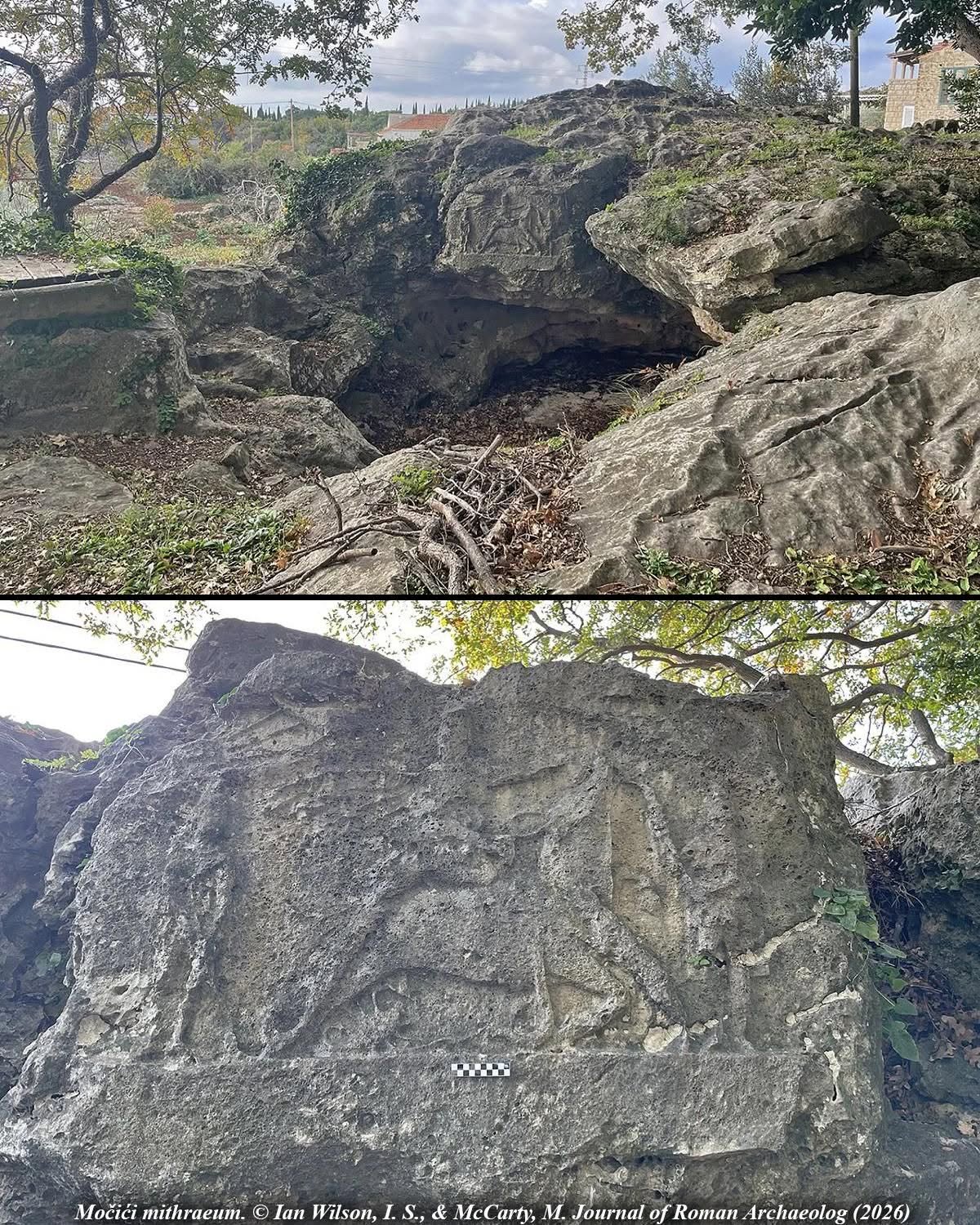
Močići breaks this pattern. The main relief of Mithras sits directly in carved limestone above a natural cave. The scene follows traditional iconography from Roman Mithraism. Mithras kills the bull, a dog and serpent appear near the animal, a scorpion attacks from below, torchbearers flank the scene, and solar and lunar figures frame the upper corners. The image reflects Roman artistic convention, yet the setting follows a different logic.
No walls, roofs, or built benches appear at the site. The cave interior measures about 17.7 square meters, far smaller than typical Mithraic halls, which often exceed 60 square meters. Such limited space would not support ritual dining in the usual Roman style. The relief also sits in a position where interior viewing becomes difficult. From outside the cave, the image aligns with the surrounding landscape and becomes fully visible.
Researchers mapped the area using photogrammetry and field measurements. A natural hollow surrounds the cave, forming an open space about 14 meters across. This area provides room for gatherings outside. Around 120 square meters of surface surrounds the rock face. Ritual activity appears to fit this exterior zone rather than an enclosed chamber.
The site includes a permanent spring and natural limestone formations. Water flows through the area year-round. Mithraic tradition across the empire often links the god with caves and springs, sometimes through artificial imitation inside urban temples. At Močići, those features exist without alteration. The stone, water, and cave form the ritual environment without construction.

The study also records a second relief inside the cave, often linked to Silvanus, a Roman rural deity associated with forests, herding, and rocky terrain in the Dalmatian region. Local pastoral life relied on grazing in nearby hills and seasonal water sources. The spring near Močići supported livestock movement through the landscape, linking daily survival and ritual presence in the same space.
Early Iranian Mithra stood within a religious system focused on truth and cosmic balance. Roman Mithras transformed into a mystery figure of initiation and communal meals, yet retained symbols tied to rock birth and light. At Močići, the rock setting aligns with the older myth of emergence from stone, while the natural spring echoes earlier associations with life-giving water in Iranian tradition.
The research challenges earlier views of Mithraism as a fixed architectural system repeated across the empire. Instead of uniform temples built to match a cosmic model, Močići shows a place where landscape shaped ritual choices. Worshippers did not reconstruct an abstract sacred space. They gathered around existing rock, water, and open ground, using the environment as the setting for ritual practice.
The findings also show how Roman religion interacted with local conditions. In Dalmatia, limestone cliffs, springs, and pastoral land formed a daily environment for communities. Mithras worship in this region followed those features closely. The sanctuary reflects a meeting point between a Persian-rooted deity, Roman ritual practice, and the physical landscape of the Adriatic coast.