


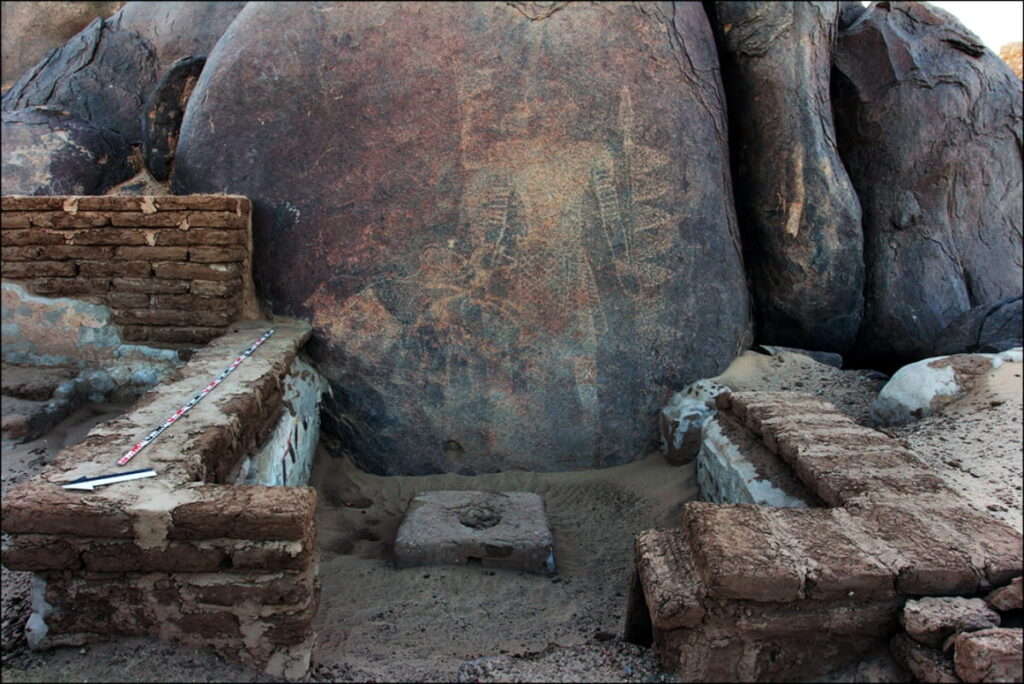

A life-size figure carved into a granite hill has watched over northern Sudan for thousands of years. The hill sits at Miseeda, in the Mahas region. Nobody knows for sure who the figure shows. Researchers think it could be a Kushite ruler. In the 7th century, local builders put up a Christian church right around it.

A team led by Dr. Joanna A. Ciesielska of the University of Warsaw studied both the carving and the church. They published their findings in the journal Antiquity. The project goes by the name Good Shepherd of Miseeda. The team combined survey work, rock art study, interviews with locals, and computer mapping to trace how the area changed over time.
The survey covered nearly 300 archaeological sites. The church was the centerpiece, but the granite hill held more. The team logged carvings of a lion, an elephant, a possible rhinoceros, and smaller cattle. Later Christian carvings turned up too, including crosses and ships. Some of those point toward the church itself.
Pottery told the story of who lived here and when. Three periods stood out as busy. The first was the Mesolithic, from 12,000 to 8,200 years ago. The second was the Late Neolithic, around 3000 to 2500 BCE. The third was the Christian era, from the 6th to the 15th centuries CE.

Finds from the Kerma to Kushite periods, roughly 1700 BCE to 350 CE, were scarce. Oddly, that gap covers the time when the carving was probably made.
The pottery also showed mixed influences. Mesolithic pots followed local styles. Later ones borrowed from both northern and southern traditions. That fits the location. Mahas sits near the Third Nile Cataract, a natural dividing zone between Egyptian-controlled lands in the north and regions farther south.
So who is the figure? The team looked at similar monuments nearby. One example is a giant carving of King Sherkarer at Gebel Qeili. Carvings on this scale are rare in the region. Sherkarer’s carving marks the southern edge of Meroitic rule. The Miseeda figure may have done a similar job, marking a borderland. Its exact age still needs to be pinned down.

The church tells its own story. Its pottery includes beakers from the early Kingdom of Nobadia and early wares styled after workshops of the Kingdom of Makuria. The builders picked a spot that had mattered to people for ages. The many Christian carvings nearby suggest the church became the center of a local sacred landscape.
Today’s residents see the place differently. The team gathered local accounts and found that the church once drew pilgrims and offerings. Now people call it Beit Kitchiner or Beit Sheitan. Some see it as cursed. Others call it miraculous. Stories link the church, a post-medieval fortress, and several water shrines to gold, spirits, and mythical places. The main sacred site today is the shrine of Sheikh Kuman in Miseeda village, which blends beliefs about water, mythical beings, and Sufism.
The researchers say the area worked as a crossroads where northern and southern cultures met and mixed for thousands of years. From Stone Age camps to medieval Nubian kingdoms, people kept coming back to this hill and giving it new meaning. The carved figure still has no name. The record around it is now much fuller.