


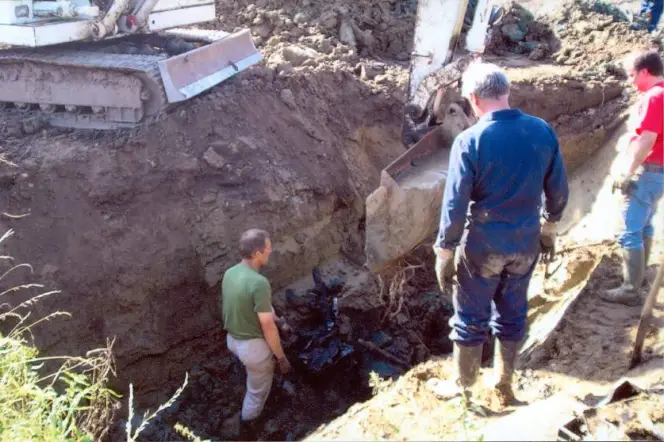

Squadron Leader George Morley Fidler’s remains were found during work on a canal. The body in a grave once thought to be his remains unidentified

For more than 80 years he has lain buried in the French mud, strapped to his seat in his doomed Hurricane, lost but never forgotten.
Now a chance discovery by engineers building a canal in northern France has at last uncovered the resting place of Squadron Leader George Morley Fidler.
Fidler, 27, who was described as an “exceptional” pilot, had only been flying Hurricanes for a few days with 607 Squadron, but had been taking the battle to the Germans as their blitzkrieg overwhelmed France, Belgium and the Netherlands.
He was shot down by a Messerschmitt on May 19, 1940, as he tried to protect British troops retreating to Dunkirk after a disastrous campaign at the start of the war.
When the wreckage of a Hurricane was found it was assumed that the dead pilot, who was hurriedly given a grave by soldiers, was Fidler. The body was later re-interred by the French in a cemetery with a proper ceremony in the village of Bachy, 20 miles away.

In 2006 a group of Franco-Belgian amateur historians with metal detectors excavated the crash site and discovered it was not Fidler’s aircraft at all, but instead belonged to Flying Officer James (Jerry) Strickland of 67 Squadron, who managed to bale out and get home.
Strickland was able to return to duty a few months later but in August 1941 was killed when his Spitfire crashed after an accident at Portreath, Cornwall. His daughter Geraldine, nicknamed Gerry, was born a month later.
The grave at Bachy, which bore a tribute written by Fidler’s heartbroken mother, Gertrude (“So he passed over, and all the trumpets sounded for him on the other side”) was given a new inscription of “unknown airman”. No one knows the identity of the man in the grave, although it is possibly one of two flight sergeants shot down that day.

The Ministry of Defence does not permit the exhuming of graves for identification purposes. However, faced with the new information, its war detectives — officially known as the Joint Casualty and Compassionate Centre Commemorations team — had a new case to investigate.
Nearly 20 years later, French workmen excavating part of the new canal at Oisy-le-Verger in the Pas de Calais found Hurricane P3535 with the squadron leader sitting upright in the cockpit.

Testing for Fidler’s DNA proved impossible because the airman from Great Ayton in North Yorkshire did not have children — and nor did his brother, Harold, or sister, Joan. He was identified by process of elimination after samples were taken from the three other pilots who crashed that day and had never been found. None matched the newly discovered body.
Nicola Nash, who led the war detectives team, said: “We are 100 per cent certain it is Morley. It has brought him to life for us … undedicating the grave where we thought he had been buried was really sad [but now] I have made contact with a cousin twice removed. He didn’t know anything about the Fidler side of the family and was amazed.”

On May 19, 86 years to the day his plane crashed, Fidler will be laid to rest with due ceremony at the London Cemetery and Extension near Longueval in northern France. There will be an RAF burial padre and a bugler will sound the Last Post.

There are 915 casualties from the First and Second World Wars there. More than half a million British servicemen who died in those conflicts have never been found.
Ian Pearce, 83, one of the Great Ayton researchers who has written extensively about “the life and death of a brave airman” from the area, said: “I started researching this about 20 years ago. It brought to life some of the events of the time and the tragedy of this young man who was shot down. People dreaded the knock on the door.”
The exceptional airman that Yorkshire remembers
Fidler has never been forgotten in his home village. There are four memorials to him, and the Great Ayrton History Society has spent years researching and paying tribute to him.
Fidler first worked at his fathers building business, but his goal was always to be a pilot. He joined the RAF in 1934, aged 21.
After two weeks’ basic training at Uxbridge, he was posted to Egypt for three years and was described as “a sound and reliable pilot, excellent on ground subjects”.

Fidler would visit Great Ayton on leave, sometimes arriving by aircraft, looping the loop over the village and landing in a nearby field.
Advertisement
In 1938 he was assessed as “exceptional” and promoted to acting flight lieutenant and a year later to flight lieutenant.
When the Second World War began in September 1939, he was posted to France as part of the British Expeditionary Force, sent to assist France in resisting the German threat.
He joined 607 Squadron and, with mayhem in the skies above, took over when the previous squadron leader, Lance Smith, was shot down and killed over Dinant, Belgium.
In a few hectic days, 607 Squadron was under siege from scores of German Dornier bombers and Messerschmitt fighters at its airfield in Vitry-en-Artois and forced to move.
On Sunday May 19, 1940, Fidler was shot down while patrolling the skies above Cambrai.
His family was already mourning his sister, who had died a month earlier after contracting a disease while working as a radiographer at a military hospital.
When the dreaded telegram arrived the home help, Ivy Hynes, could not bear to open it and got a local nurse to read it instead. “Mrs Fidler was distraught,” she said.