


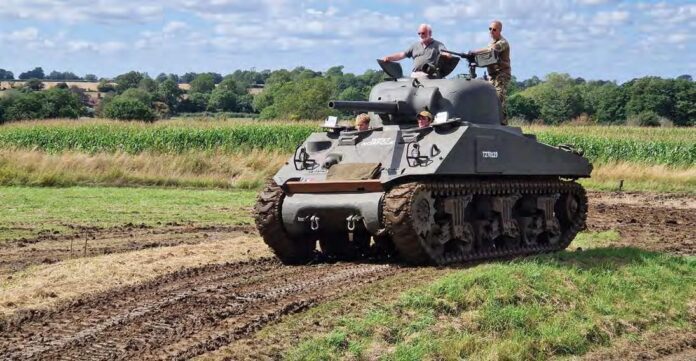

Allen Crawford’s M4 Sherman tank drew much attention at 2023’s Norfolk Armourfest. Craig Moore finds out how it was salvaged as a rusty wreck and lovingly brought back to life
Imet up with Allen Crawford at the Norfolk Tank Museum’s Armourfest 2023 and we had a chat about his restored M4 Sherman tank. Its serial number is 551, which means it was one of the earliest M4 Shermans to come out of the factory gates.
It has a riveted rather than welded lower hull and was built by the Pressed Steel Car Company in September 1942. The British Army gave the M4 Sherman the designation Sherman I, and this particular example was issued with the British Army War Department number T270129.
The Contract Card held at The Tank Museum Bovington Archives shows it as being part of a mixed batch contract of Sherman I and Sherman V tanks received in the latter half of 1944. This example was recovered from the Feldom Ranges, Catterick Training Area in Yorkshire.
In July 1942, production of the M4 Sherman tank started at the Pressed Steel Car Company. The M4 variant hull was welded, whereas the hull of the M4A1 was cast. This angular welded hull provided more room for ammunition storage – for example, the M4 could carry 97 of the 75mm rounds, whereas the M4A1 could only carry 90 of them.
Both tanks were powered by the same Continental R975 radial engine that provided a top road speed of 24mph. Holding 175 gallons of fuel gave the tanks an operational range of around 100 miles before they needed to be refuelled. The front upper armour of the M4 Sherman was 50.8mm thick, angled at 56°, which gave an effective armour thickness of 90mm. The turret gun shield was 88.9mm thick and behind that, the front turret armour’s thickness was 76.2mm.
The first military vehicle Allen ever owned was a Jeep. He was 16 at the time. He never intended to go into the restoration of military vehicles as a hobby, rather, he had planned to modify his Jeep as a hot rod – mirroring the vehicle conversions he had seen completed in American car magazines.
However, he soon realised that at that stage, he did not have the skills required.
Allen then decided to restore the Jeep back to its original wartime condition, using skills he had learnt in his father’s truck and coach business workshop as a heavy mechanic.
Once he had completed restoration of his Jeep, Allen looked around for another project and soon found another Jeep for sale on the back of a GMC lorry at a dispersal dealer in Norfolk. The dealer would only sell the two vehicles together as a job lot for £750, which was a lot of money 50 years ago. Once he had finished restoring the second Jeep, he took it to a military vehicle event at RAF Duxford. It was there he saw for the first time a restored GMC lorry. It dawned on him he had his next project waiting for him at home.
Allen took his three vehicles to France for the 40th anniversary of the D-Day landings with his friends and thoroughly enjoyed being involved in this type of event. He saw a couple of command cars in France and decided he wanted to restore one of them next. After searching the adverts in his local newspapers and those in the Exchange and Mart he finally found one. Over the next 40 years, Allen continued to restore more wheeled vehicles, including some that could swim like DUKWs.
Allen has left all his M4 Sherman’s scars, weld marks and casting marks visible to see to enable its history to be told

The .50 cal. Browning M2HB machine gun mounted on the rear of the turret is a replica
He had always shied away from restoring a tracked armoured vehicle, even though he lived on a farm and could have driven it around the fields. The main reason for this was the difficulty of transporting a heavy-tracked vehicle to events, and because the tracks would cause damage to road and concrete surfaces around the farm. In 2005, he changed his mind when he took part in the Tanks in Town event with his soft-skinned vehicles. Allen became intrigued watching the big heavy tanks negotiating the narrow Belgian streets as they did in 1944. He ended up buying a 76mm Gun Motor Carriage M18 Hellcat and drove it in convoy at the next Tanks in Town event. That vehicle is now in America.

Allen drove his M4 Sherman around the arena at the Norfolk Tank Museum’s Armourfest 2023. It coped with the mud on the corners easily


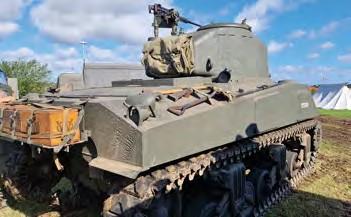
The additional armour plates welded to the hull sides were designed to give added protection to the crew

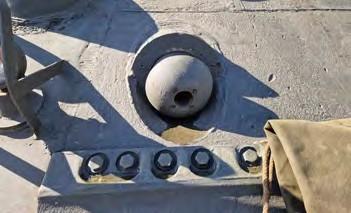
This is the front hull machine gun ball mount. The machine gun is missing at present
Allen decided he would like to own a Sherman tank, so purchased an M4 Sherman wreck from a firing range. It had been recovered by an approved contractor with heavy lifting equipment. The tank had been filled with concrete to make it more stable for live firing exercises. When it was no longer required as a hard target, it had been buried. The right side of the tank was complete, but the rear section on the left was destroyed, and the front of the glacis plate had been caved in.
A deal was made that included the tank hull, a correct turret from a different range in Europe and lots of spare parts. He still had to make many visits to European military parts dealers to buy required bits, with some parts coming from as far away as Australia. The original Continental radial engine was severely damaged but has been kept, as Allen intended to drive the tank at events and on armoured convoys.
The small arms bullet and shrapnel scars on the turret side have been left visible. Evidence of its time on a Dutch army firing range
Allen worked on the tank in a barn on the farm, with part of the building being rented out to a bespoke metal fabricator, who also has a collection of World War Two vehicles. This became very handy for Allen, as the skills and equipment necessary to complete some of the restoration work on the Sherman was easily available.
Allen said: “People thought I was bonkers when they first saw the Sherman. It was in a very bad state. They couldn’t understand why I had swapped good condition restored vehicles for this wreck.”
Most of the concrete had been extracted by the use of a Kango hammer before Allen had become the owner of the tank. However, the remaining concrete had to be removed before welding could begin, as that process needed clean edges. The hull was stripped of all its fixtures and worked on first. The original front glacis plate was beyond repair, so it was cut out and replaced with another that had come from a range in Holland. RSJs were welded down the side of the hull and joined together to function as a clamp before the work started. Sections of the damaged glacis plate were cut away, and the new armour was added in sections. Adrian Barrell provided a ‘barrel turner’, a large device used to turn vehicles 360° to enable welding at the correct angle.


This early production M4 Sherman has a rare feature; it has a riveted rather than welded hull
Allen explained: “The tank had E9 suspension extensions bolted to the hull. These were modifications added to the sides of each tank track link, making the tracks wider. This reduced the amount of ground pressure the tank exerted and enabled it to cross softer ground more easily without getting stuck. It is a very early tank, so I decided to remove the later extensions and restore the suspension back to how it would have looked in 1942 rather than in 1945.”
The inside of the hull was painted white. The bulkhead did not have to be altered to accommodate the new engine, as the original Continental radial engine was compact in size, and the compartment was short compared with other versions of the Sherman.
Allen could not fit a V8 diesel engine, so he had to find a V6 engine that had enough power and could fit in the available space. He chose to fit a rebuilt mid-1970s-designed Detroit 6V92 turbo diesel 400hp engine. A bespoke radiator and fan system was built to fit into the top of the engine compartment.
The new clutch system was designed to work with the Continental radial engine, with Mike Gillman of Green Barn Services helping to make the conversion work. A new old stock M4 transmission was sourced and fitted. Salvaged cast metal bogie units and track links with rubber pads for use on roads were supplied with the tank, but Allen had to visit dealers in Holland to get the parts needed to put them back together.
‘Once he had completed restoration of his Jeep, Allen started to look around for another project’


The .50 cal. Browning M2HB machine gun mounted on the rear of the turret is a replica


The white X on a blue square with a smaller red square in the top right corner indicates that the tank belonged to the Battery commander’s tank of the 1st Battery
He said: “It took about a day to refurbish a bogie and that was with three men working on each one. The only way we could loosen some of the volute coiled springs was to put them in a fire, so the metal expanded. When the springs cooled down, we found the coils separated and we could then take them to bits to recondition them.”
A modern wiring loom had to be fitted that would be compatible with the Detroit diesel engine. Alongside this, a new instrument panel was fitted with the nonworking original dials. Adrian Barrell also fabricated a new platform for the driver’s levers as the original had disintegrated. Carl Brown assisted with restoring the frames for the crew’s seats and Jim Clark provided the canvas covers.
The 75mm gun in the turret is demilitarised and at present does not have the gunner’s optics. The two .30 calibre Browning M1919A4 machine guns – one in the ball mount in the hull and the other coaxially next to the main gun – are both deactivated. The .50 calibre Browning M2HB machine gun mounted externally on the rear of the turret is a replica.
The top of the turret has a substantial dent in it from being hit by a shell on the range. The damaged area was heated red hot, while the inside was suspended under the dent on a platform on the inside. The whole weight of the heavy turret was pulling down on the red-hot metal area. It did not budge. Allen has left it with the dent visible rather than filling it, as evidence of its history.
Luckily, the turret and hull hatches were in a reasonable condition to enable them to be restored and refitted to the tank. Periscopes have been purchased for the hatches. The base of the turret was not warped, and fitted onto the new old stock turret ring bolted to the tank hull. Marcus Glen lent Allen his Sherman tank turret basket to enable a copy to be made and fitted inside the turret.
Dramatic debut
The tank’s first outing was for the Armour and Embarkation event in 2022 in Dorset. It completed 25 miles and reached The Tank Museum at Bovington before it had a mechanical issue and had to be towed the rest of the route. I asked Allen what the problem was. He said: “I found out that the air filter fitted to the tank was too small, and this combined with the new silencer was constricting the engine.

The metal bucket of a digger was used to right the tank
‘What I like about Allen’s M4 Sherman is its ‘honest’ appearance, and the story it tells’
“When the tank packed up going up a hill it blew the exhaust pipe off and filled the tank with black smoke. Inside the tank, we were terrified that it had caught fire and got out quickly.
“Ironically, I have been asked to take part in the Armour and Embarkation event in 2024.”
Because of current French Customs problems, Allen will not be taking his tank to the 80th D-Day celebrations but would instead like to take it to the next Tanks in Town event around Mons in Belgium.
“I love the venue and what goes on,” he said. “I took the Hellcat to the Battle of the Bulge ‘Nuts’ event one December.
It was a long way to go, and it was very cold, but it is a lovely part of the world.”
I asked Allen why there are the words ‘West Norfolk’ on the front of the glacis plate. He replied: “My grandfather was in the Leicester Yeomanry in World War One. I went on their website and found a photograph dating to World War Two of a Sherman tank with the words ‘West Norfolk’ on the front. I copied all the visible markings I could see on the photograph and applied them to my tank.
Their vehicles were all named after local fox hunts.”
In early 1940, the Leicester Yeomanry was split into two separate regiments. In February 1940, both units were absorbed into the Royal Artillery as the 153rd (Leicestershire Yeomanry) Field Regiment, Royal Artillery, and the 154th (Leicestershire Yeomanry) Field Regiment, Royal Artillery.
The 153rd was issued with 25-pdr Sexton self-propelled guns and was attached to the Guards Support Group in October 1941. In June 1942, it became part of the Guards Armoured Division going to Normandy in June 1944 after D-Day. Most Sexton Regiments possessed a number of Shermans as observation post tanks. The white X on a blue square with a smaller red square in the top right corner indicates that the tank belonged to the battery commander’s tank of the 1st Battery. The number 78 was the unit code for Counter Mortar battery in an armoured division.
What I like about Allen’s M4 Sherman is its ‘honest’ appearance, and the story it tells. All its scars, weld marks and casting marks are visible to see. They have not been filled in, welded over or sanded smooth. Any visible smooth areas on the tank are where new bits of metal have had to be welded in place. The contrast between the rough casting marks left on the tank and the new smooth metal surfaces helps you spot where the repairs have been made.
If you are lucky enough to see this tank at a future event, make sure you examine the early production lower hull riveting. It is very unusual to see this in a restored Sherman tank, as most have welded hulls.


When the tank was recovered the caved in glacis plate and the severe damage to the turret could be seen