


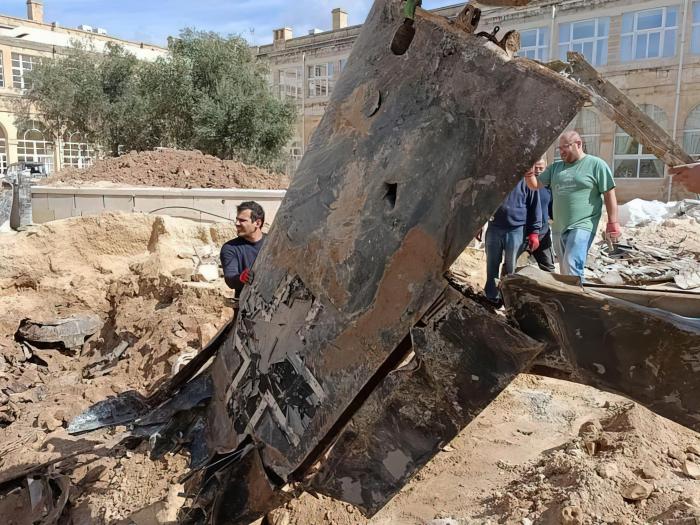

In the field of aviation archaeology, major historical discoveries frequently emerge from unexpected locations. The recovery of a World War II Luftwaffe fighter from the grounds of a residential care facility stands as one of the most remarkable tactical excavations in Malta’s history.
What began as routine trenching for a new garden layout at the St Vincent de Paul Residence—situated near a historical perimeter of Luqa airfield—ultimately solved a decades-old combat puzzle. The operation delivered a wealth of structurally significant artifacts to the Malta Aviation Museum preservation hangar at Ta’Qali.
       [April 1, 1942: Bf 109 F-4Z Shot Down by Flak over Malta; Pilot Survives]
                                          │
                                          ▼
       [Post-Crash: Chopped Wreckage Dumped and Covered in a Bomb Crater]
                                          │
                                          ▼
[Routine Trenching for a Dementia Patient Garden Unearths Aircraft Debris]
                                          │
                                          ▼
 [Superintendent for Cultural Heritage & Museum Team Launch Excavation]
                                          │
                                          ▼
  [Recovery of Werknummer 8668 Wing, 'Black 11' Fuselage, and Tropical Filter]

An Unexpected Discovery in the Garden
The archaeological site was uncovered during ground excavation for a garden dedicated to dementia patients at the care facility. Construction workers exposed a substantial concentration of buried aircraft debris, prompting immediate monitoring by an on-site archaeologist.
When Ray Polidano, Director-General of the Malta Aviation Museum Foundation, received notice of the find, the museum’s lead engineer, David Polidano, initially approached the report with professional skepticism. However, an initial site inspection inside the 3-meter-deep excavation crater completely changed the scope of the project. Bending close to the exposed structure, investigators discovered a small, intact data-plate reading AGO, stamped with a part number beginning with 109 and ending in F2—definitive proof of a Messerschmitt Bf 109 airframe.
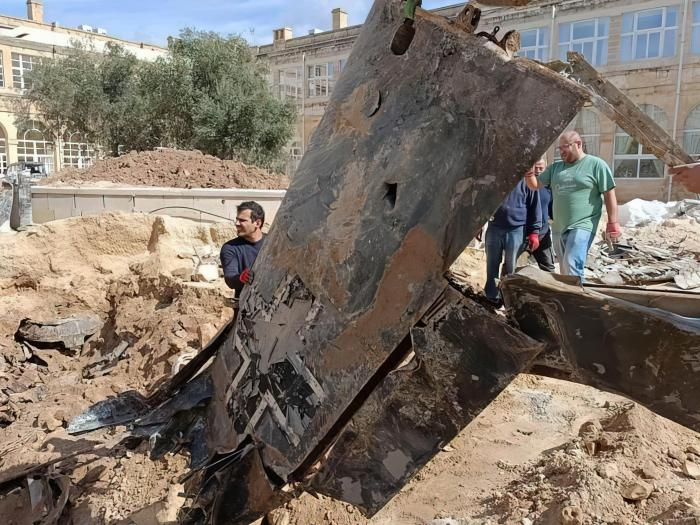
Unearthing the Components of ‘Black 11’
Following formal operational clearance from the Superintendent for Cultural Heritage, a specialized five-man museum team and the on-site archaeologist initiated a systematic recovery operation. The physical layout of the site confirmed it was not an isolated crash impact zone, but rather a wartime disposal site where airfield clearance crews had buried salvaged debris inside an open bomb crater.
Over several days of manual and mechanical digging, the excavation team successfully recovered major structural assemblies:
- The Wing Structure: The aircraft’s complete port wing was cleared of debris and lifted with a mechanical excavator, revealing the factory-painted identity Werknummer 8668 at the wing root.
- The Fuselage Sections: Directly beneath the wing assembly, the team uncovered three separated, chopped-up sections of the rear fuselage. The aluminum skin behind the cockpit area retained its highly visible “Black 11” tactical markings, while the rearmost tail section preserved its original white theater band and horizontal bar paint.
- Engine and Cockpit Elements: Additional recoveries included a complete port tailplane, the port cockpit skin side panel, and the forward port engine cowling, which still housed the intake mechanism for its specialized tropical air filter.

Technical and Historical Profile: Messerschmitt Bf 109 F-4Z
| Feature / Identifier | Historical Context |
| Aircraft Type | Messerschmitt Bf 109 F-4Z (Tropical Variant) |
| Manufacturer | Erla (Built between August and December 1941) |
| Production Batch | Werknummer Batch 8400–8806 |
| Specific Airframe | Werknummer 8668 |
| Tactical Marking | “Black 11” |
| Assigned Unit | 5. Staffel, II./JG 3 (Jagdgeschwader 3) |
Tracking the Fate of Unteroffizier Hans Pilz
By cross-referencing the verified Werknummer 8668 and the “Black 11” tail markings with historical combat records—specifically documentation within Anthony Rogers’ historical volume Battle over Malta—researchers established the exact operational timeline of the fighter.
On April 1, 1942, during the height of the intense aerial campaign over the island, this specific Bf 109 F-4Z engaged in a combat sortie. The aircraft sustained catastrophic damage from British anti-aircraft fire, forcing it down. Miraculously, its 23-year-old pilot, Unteroffizier Hans Pilz, survived the emergency crash-landing and was taken prisoner of war for the remainder of the conflict.
Following the crash, British airfield clearing teams chopped up the non-functional airframe and tossed the remaining components into the nearby crater to restore the surface of the field. Today, through the alert response of the care home staff and the field recovery work of the Malta Aviation Museum, these pieces are preserved as tangible links to the air battles of the Mediterranean theater.