


Chicago, like a lot of other modern cities, has a hidden secret: It’s home to miles of passageways deep underground that allow commuters to get from one place to another without risking nasty weather. Los Angeles, Boston, New York, and Dallas all have their own networks of underground tunnels, as well. But there’s a place in Eastern Europe that puts those forgotten passages to shame. Welcome to Derinkuyu — the underground city.

A Subterranean Suburb
Picture this. It’s 1963, and you’re on a construction crew renovating a home. You bring your sledgehammer down on a soft stone wall, and it all crumbles away, revealing a large, snaking passageway so long that you can’t see where it ends. This is the true story of how the undercity at Derinkuyu was (re-)discovered. While those workers knew they’d found something special, they couldn’t know just how massive their discovery had been.
Stretching 250 feet (76 meters) underground with at least 18 distinct levels, Derinkuyu was a truly massive place to live. Yes, live. There was room for 20,000 people to stay here, complete with all of the necessities (and a few luxuries) — fresh water, stables, places of worship, and even wineries and oil presses. It isn’t the only underground city in the area known as Cappadocia, but it’s the deepest one we know of, and for many years, it was believed to be the largest as well. (Another recently discovered location may have been home to even more people.)

Derinkuyu and the other 40-ish underground cities nearby are made possible thanks to the prevalence of tuff in the area, a kind of volcanic rock that solidifies into something soft and crumbly. That makes it relatively easy to carve enormous subterranean passages — but why would you want to? The answer lies in the cities’ origins.
Defense Against the Sword Arts
Derinkuyu isn’t exactly inhospitable on the surface level (after all, that’s where the people who found it were living). So why did ancient people decide to build their living quarters below the surface? Because they weren’t hiding from the broiling sun or annual meteor showers. They were clearly hiding from invading forces, with massive, rolling stone doors to block off each floor should any armies breach the fortress. But who were the people of the caves, and who were they defending themselves against? The answer to the second question depends on the answer to the first.
The earliest known people to live in the area were the Hittites, who ruled the Turkish Peninsula from about the 17th to 13th centuries B.C.E. — well over three millennia ago. Some scholars point to artifacts with Hittite cultural elements, such as a small statue of a lion, found in the underground caves. That suggests these ancient people would have been taking refuge from invading Thracians.

If they were, it didn’t work forever: A tribe of Thracians, the Phrygians, conquered the area next. It’s possible that the Hittites never lived underground, however; an alternate theory says that it was the Phrygians, not the Hittites, who spawned the subterranean city. Since the construction of many of the large underground complexes is dated to some time between the 10th and 7th centuries B.C.E., and the Phrygians lived there until the 6th century B.C.E., they’re generally regarded to have created the first caves. In that case, they may have been hiding from the Persian host under Cyrus the Great that eventually did take over the region.
Lost and Found
The Persians would have used those caves as well, as would all of the people to come after. Eventually, according to some sources, early Christians around the 2nd century C.E. took root in the caves as they fled Roman persecution. This pattern continued throughout the centuries and millennia to come — in fact, Greek Christians were still using the caves as late as 1923. It’s pretty incredible, then, that the caves would have been forgotten in the 40-odd years between their last residents and their “re-discovery.”
It’s more likely, then, that it wasn’t the caves themselves, but the extent of the caves that was forgotten. While the holes burrowed into the area’s fairy chimneyswould have been obvious even from a distance, it’s likely that the people living in more modern accommodations never realized that the caves in the wilderness outside of the urban area reached 18 stories down.
Had the spring field season gone according to plan, I would have been heading back down to southern Mexico with my fellow cavers to continue our push ever deeper into Sistema Huautla, which, at 1,560 meters, is the deepest cave system in the Western Hemisphere. This year, I was to have been joined by a team of 27 of the world’s top speleologists from five countries. With the coming of the Covid-19 pandemic, however, we were forced to scrap our April-May expedition two weeks prior to departure.
With my international travel feathers temporarily clipped, and not one to sit idly by, I decided to turn my proverbial headlamp back onto speleological treasures closer to home—in this case, a world-class “show cave” known as Natural Bridge Caverns (NBC) on the outskirts of San Antonio, where last summer we discovered some 500 meters of previously unknown passageways. These are the first to be found since the Texas Hill Country cave was designated a National Natural Landmark in 1971, and it is funny to think, they might never have been found had it not been for chance discussion with Orion Knox, a friend of many years who, along with three of his fellow St. Mary’s University students—Preston Knodell, Al Brandt, and Joe Cantu—had discovered NBC back in March of 1960.
Bennett Lee
In October 2018, Orion agreed the lead a tour of NBC for fellow members of the Texas Chapter of The Explorers Club, after which my partner Diana Tomchick asked if there were any remaining passages to be explored. With a slight smile, he pointed to a place on a map of the cave marked the “Dome Pit,” well beyond the extraordinary chambers that are open to the public.
Orion said he suspected that there was a passage near the top of the dome, but when he and his buddies surveyed the cave back in the 1960s, their carbide lamps were not bright enough to see if indeed there was one. He also highlighted the fact that the Dome Pit’s walls were soft in places, making it difficult, if not impossible, to climb. My curiosity piqued, I smiled at Diana. Without saying a word, we knew it probably could be climbed by someone with the right skill set. I knew just who to call—Lee White, who had been a key member of our Sistema Huautla team since 2017. But before I reached out to Lee, Diana and I would scope out the situation firsthand.
In February 2019, we returned to NBC, where we met up with Brad and Travis Wuest, third-generation owners of the caverns, which happened to be located on private property. After a brief discussion, we set off for the Dome Pit along with the brothers and two of their NBC guides and surveyors, Justin Royce and Dillon Ellis. Passing beyond the exit tunnel that marked the end of the paved tourist trail within the cave, we went over a handrail, down a flight of concrete steps, and into a suite of undeveloped passageways and chambers, including a massive one known as the Inferno Room, which is filled with blocks of rock and dangling speleothems. Within minutes we found ourselves squeezing, climbing slippery muddy slopes, stoop-walking, belly crawling, and working our way through constrictions, which necessitated contortionist moves. An hour and a half later, we reached the Dome Pit.
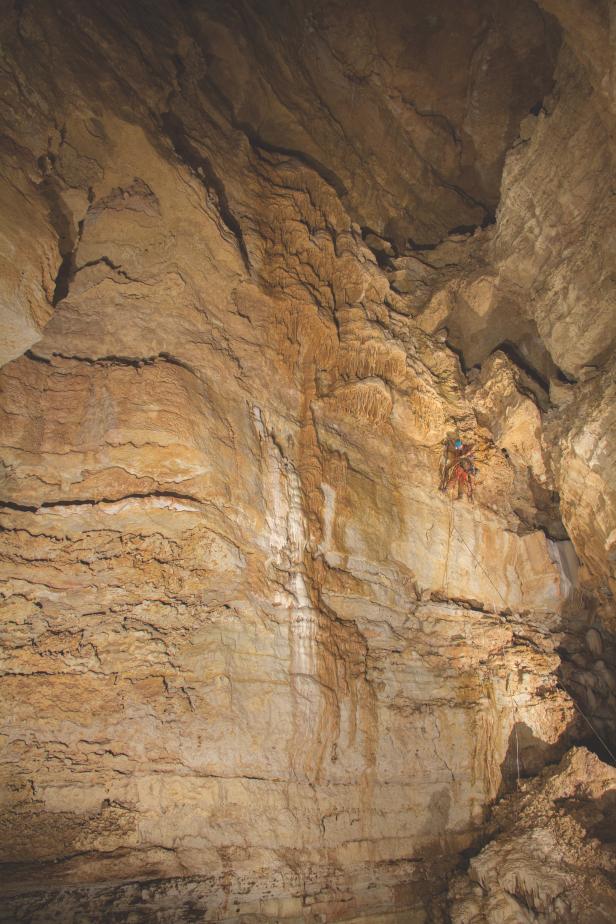
Its light-colored limestone walls towered more than 30 meters up to a rather flat ceiling. Our bright Scurion headlamps lit up the chamber and it appeared that was indeed a large passage at the top, which could be reached using serious aid climbing. Following our inspection, I got in touch with Lee and he agreed join us for our return to the Dome Pit in early May, once we had concluded our spring Huautla expedition. In the meantime, the Wuest brothers would return to the Dome Pit with a drone operator who flew his craft up to the ceiling and into the passage at the top, which appeared to contain large stalagmites.
Following an early morning planning session on May 8, made our way back to the Dome Pit, where Lee immediately began scanning the walls for a suitable route to the top. Within minutes he started up, setting a suite of bolts in the rock as he made his ascent with me belaying from below. An hour and a half later, Lee reached the top, shouting down to us, “It goes!”
He pulled up the belay rope, rigged a static that would provide access for the team, and rappelled back down, removing the hangers along the way.
Bennett Lee
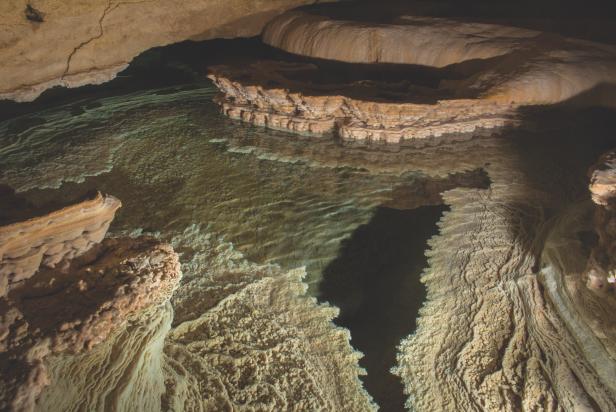
One by one we jumarred our way up and into the previously unknown passage. Nearly 200 meters in, we came to a large pit in the floor with the passage continuing for another 100 meters beyond it before terminating in “T.” Dropping into the pit in the floor, which about 30 meters deep, we encountered into a nice-sized passage with rimstone dams, pools of crystal-clear water, and large stalagmites. It was clear then that the passage opened up with impressive formations much like the ones for which the show part of the cave is known, which warranted further exploration.
Since our initial foray into the cave in 2019, we have returned to the cave several times with plans to continue our push into the system later this fall and early next year with more than 600 meters of new cave passages having been explored and mapped, both traditionally and with the aid of LIDAR. And our excitement continues to build about NBC’s potential, tempered only by the sudden loss of Lee White. In September 2019, the best cave wall climber in the world was tragically killed in a car crash at age 31. We plan to carry on his unbridled spirit as we continue to explore one of Earth’s great geological wonders.
About C. William “Bill” Steele
Steele has ventured into some of the deepest caves in the world, including Sistema Huautla in the Mexican state of Oaxaca, where he has led more than a dozen Explorers Club flag expeditions over the past four decades. Since 1970, Steele has been involved in the exploration and mapping of Mammoth Cave in Kentucky, the world’s longest cave. Leading cave photographer, Bennett Lee, started caving as a teen with Bill Steele some three decades ago.