


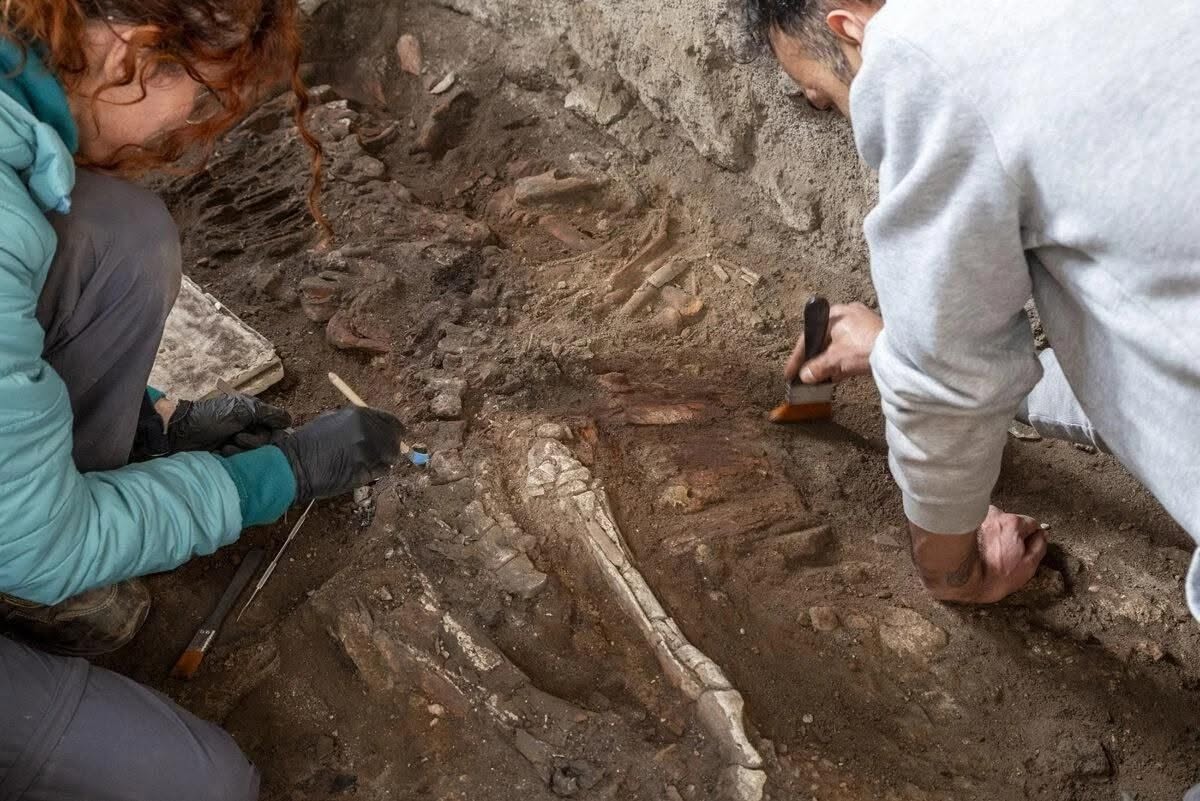

Pompeii’s House of the Chaste Lovers has produced new evidence about the lives of working animals in the ancient city. Archaeologists excavating the bakery complex found the skeletons of two equids, likely horses, donkeys, or mules, buried beneath the remains of a collapsed building. The find offers a rare look at the final hours before Mount Vesuvius destroyed Pompeii in CE 79.

The animals were uncovered during a project aimed at cleaning and re-examining areas first excavated in the late twentieth century. In a room beside the bakery oven, researchers removed a section of soil left untouched during earlier work. Beneath it lay the remains of two large herbivores positioned against a wall.
The House of the Chaste Lovers ranks among the most important excavation areas in Pompeii. The complex preserves a large bakery complete with ovens, storage rooms, work areas, and living quarters. Previous excavations revealed stables and other equids used for milling grain and transporting supplies needed for bread production.
Researchers believe the newly found animals had been moved into a temporary holding area while repairs took place elsewhere in the bakery. Archaeological evidence points to renovation work underway shortly before the eruption. Nearby stable facilities had suffered damage from earlier earthquakes. Workers appear to have been rebuilding parts of the complex when disaster struck.

The room where the animals died measured roughly 6.3 by 3.45 meters. Bread was no longer prepared there. A large worktable once stood inside, supported by limestone blocks. By the time of the eruption, the table had been removed, leaving open space where the animals were housed.
The older animal, identified as RP1, was found in the northern section of the room. Examination of the teeth and bones suggests an age of around 10 to 12 years. The second animal, RP2, was younger, between about 3.5 and 6 years old. Researchers have not yet determined whether the animals were horses, donkeys, or hybrids. Further biometric studies and genetic testing are planned.

One of the most notable finds came from the neck area of RP1. Archaeologists recovered two iron rings linked to a harness system. Nearby they found three glass-paste beads, one blue and two white, still grouped together. The beads likely formed part of a decorative collar or strap attached to the animal’s harness. No similar ornament appeared near RP2.
The presence of the beads suggests a relationship between people and the animals beyond their role as laborers. The older equid appears to have received a level of care reflected in the decorative elements found with its remains.
The geological evidence tells an important part of the story. Researchers found no lapilli, the small pumice stones produced during the early phase of the eruption, around or beneath either skeleton. This detail indicates the animals died before volcanic debris began accumulating inside the room.

A large wooden beam lay above the skeletons. Analysis identified the wood as maple. The beam had burned and later became buried beneath ash. Archaeologists believe part of the upper floor collapsed during the first stages of the eruption, crushing the animals. Tremors preceding the main eruption may have triggered the collapse.
Fragments of wickerwork and thick layers of ash surrounded the remains. Evidence suggests fire burned for some time before hot volcanic gases and ash created conditions that stopped further combustion.
The excavation brought together archaeologists, archaeozoologists, archaeobotanists, and forensic specialists. Their work focuses on reconstructing everyday life in Pompeii as well as the sequence of events during the city’s destruction.
Laboratory studies continue. Researchers hope to learn more about the animals’ health, species, and role within the bakery operation. The findings add another piece to the history of Pompeii, where traces of both human and animal lives still survive nearly two thousand years after the eruption.