


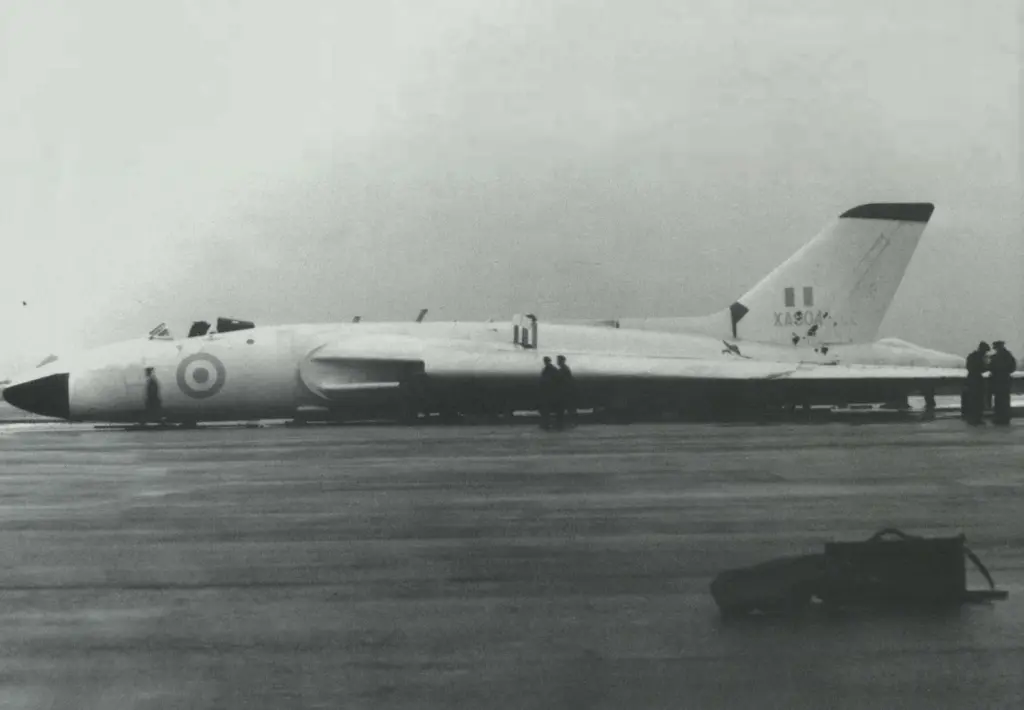

On 28 February 1961, Vulcan XA904 took to the air during a sortie, only to find itself crash landing in the early hours of the 1 March. This article from the 1997 edition of ‘The Vulcan’ tells the full story.
Well if you run out of petrol in your car you can always push it to the nearest petrol station. This is not so if your Vulcan starts to cough and splutter, as one crew sadly found out!
XA904 was a B.Mk.1A with the Waddington Wing when it took to the air late in the afternoon of the 28th February 1961.
The sortie was to consist of a ‘complex’ stage, followed by continuation training, which would extend the flying time to a little over six hours. The aircraft roared away from Waddington at about 1800 hours and the first stage, the complex stage, was completed without incident and ‘904 was back over the airfield at about 2320 hours. The crew believed they had about 20,000 lbs of fuel, although it was later estimated they would have only had around 17,500 lbs.
After doing seven approaches and three roller landings the captain, at 0035 (now the 1st March), handed the controls over to the co-pilot. Fuel checks had been completed at 0026 and 0030 by both the co-pilot and captain. At 0036 a further fuel check was taken by the captain which he calculated to be just over 6,000lbs but the rear crew obtained figures of only 4 to 5,000lbs. Unfortunately, the captain was not informed of the discrepancy and carried on with the sortie.
After the co-pilot had completed a couple of circuits the captain took control. The aircraft had by now been airborne for 6 hours 40 minutes, when on the downwind leg, of what was to have been the final circuit, the co-pilot estimated to only have 4,000 of fuel and informed the captain just as the low-pressure fuel ‘dolls-eyes’ began to flicker white. The captain looked at his gauges for only a split second, but this was enough for him to come off his flight path, making him go around again.
He completed a very tight turn, but on the downwind leg all the fuel indicators went permanently white. Three of the generators came ‘off line’ and nos. 1, 2 and 3 engines failed. He put out a ‘Mayday’ call, selected airbrakes out fully and threw the Vulcan at the runway.
The sad thing was that he had almost made a successful landing. The port main wheels hit the runway first at about 120 knots, which was not really the problem, but with very limited power the Vulcan ran off to the left. As the port wheels hit the soft grass the undercarriage was ripped away, quickly followed by the others, before being swung a full 180 degrees on her belly.
The aircraft tanks were drained and they showed it had only 300lbs of useable fuel left in onboard tanks. A Board of inquiry subsequently Court Martialled the captain and issued the following orders to all Vulcan squadrons: Minimum fuel on returning overhead was to be 12,000 lbs; Minimum fuel for roller landings or practice overshoot was to be 10,000 lbs, and Minimum fuel on landing was to be 8,000 lbs.

Service History
Ordered on the 22nd July 1952 as part of the first batch of B1s under Contact 6/Aircraft/8442/CB.6(a). On the 13th July 1957 it was cleared as Airworthy and was collected by No. 83 Squadron three days later. This aircraft was the first off the production line with the new improved Olympus Mk. 102 engines fitted. It was temporarily withdrawn from service while it was converted to a B.MklA and returned to service on the 20th January 1961 to serve with No. 44 Squadron. The conversion basically improved the type with the fitment of advanced Electronic Counter Measures (ECM) equipment, which was housed an additional rear bulge which was standard on the B2. The accident on the 1st March 1961 was originally assessed as Cat. 4, but later classed as Cat. 5 and was struck off charge on the 10th May. It was finally scrapped at Church Fenton by No. 60 Maintenance Unit (MU), although the nose section was saved and allocated the serial 7738M and moved to RAF Finningley in the December of the same year before disappearing without trace.

Above, In the foreground is the nose of Vulcan B.Mk. 1, XA902, while in the background is XA904. This photograph was taken at RAF Waddington, in 1957, shortly after they entered service.
These were the first two Vulcans to arrive at Waddington in the white paint scheme. ‘902 served with 230 OCU, bringing their compliment up to full strength, while ‘904 was the first delivered to No. 83 Squadron. It is interesting to note that XA903 had not been allocated to the RAF, but was in the process of being modified to carry Blue Steel.
We have just read the fate of XA904 when it belly landed at Waddington after its sortie on the 28th February/1 st March 196 1, but a similar fate had bestowed ‘902 on the 28th February 1958, when also landing at Waddington.
While on its 121st flight, which lasted only 40 minutes, XA902 landed on Waddington’s main runway with 379 hours 10 minutes flying time on the airframe. It was a Friday evening and snow had been cleared off a centre section of the runway into banks either side of the landing strip and as ‘902 landed the aircraft swung off the strip, hitting the piled up snow.
It was later discovered that the undercarriage had collapsed due to metal fatigue in pins before it had hit the snow bank. Upon further investigation it was found that seventeen other Vulcans were suffering from a similar problem. After modifying the pins, by using cadmium-plated bolt ends, the problem was rectified.
XA902 was originally classed as Cat. 5, which would have resulted in it being scrapped, but it was later reevaluated as Cat. 3 and was moved by road to Woodford on the 1st November 1958 where it underwent repairs. After two test flights on the 14th and 15th July 1959, it was finally delivered on the 17th to Rolls-Royce at Hucknell where it replaced VX770 which had crashed almost a year before.