



Dog walker Keith Armstrong couldn’t believe his eyes this week when strolling along a Northumberland beach.
Remains of World War Two anti-tank defences have reappeared 80 years after they were built to repel a possible Nazi invasion.
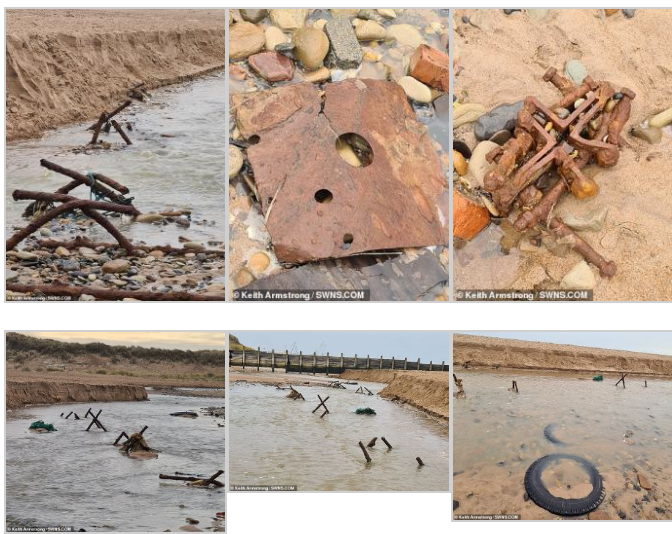
Low tides and heavy storms in the north east shifted tonnes of sand to unearth the military hardware and rusted shells on Blyth Beach in Northumberland. In 1940, anti-tank sea defences were installed on coastlines across Britain to protect against a potential Nazi invasion. The steel defences however, were never needed with most being left to rust in the sand.
Keith captured the scenes while taking his dog for a walk on Blyth Beach in the second week of January.
He said: ‘The floods have uncovered the World War Two beach defences. You can see the low wire entanglement which mines would have been strung to. ‘It was pretty strange to see these defences poking up through the sand again after so much time.’
Keith’s pictures also reveal military tyres and rusted traps which have become embedded in the sand.
The defence measures were backed up by nearby Blyth Battery which was constructed in response to the December 1914 German bombardment of Hartlepool but brought back in to use during the Second World War.
The battery was re-excavated in February 1940 and was manned by 110 soldiers and five officers and armed with two gun emplacements fitted with two six-inch BL MK.7 guns in anticipation of a German invasion known as Operation Sea Lion.
153 Emergency Coastal Batteries were constructed in 1940 in addition to the existing coastal artillery installations, to protect ports and likely landing places.
In 2017, a pillbox was unearthed in Embleton Bay, further north in Northumberland, after similar bouts of heavy rain.
The traps on Blyth Beach are several feet high, were set in 1940 when the country feared that Britain might be invaded after the evacuation of Dunkirk.


Blyth Beach was considered the first coastal point north of the Tyne river where an invasion was possible and so defences were set up on the beach as well as other beaches all the way up to Berwick-upon-Tweed.
They were part of a long coastal line of barricades to prevent enemy tanks from moving inland if they successfully reached the shores.
We hope this stretch of the Beach becomes protected for its historical value and recorded before the sands eventually retake them.
All images by Keith Armstrong.